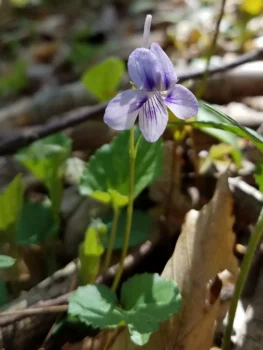
Longspur Violet: A Charming Native Wildflower for Shade Gardens
If you’re looking to add a touch of woodland charm to your shade garden, the longspur violet (Viola rostrata) might just be the perfect native wildflower for you. This delightful perennial brings subtle beauty and ecological value to naturalized landscapes across much of eastern North America.
What Makes Longspur Violet Special
The longspur violet gets its common name from the distinctive long, curved spur that extends from the back of its purple flowers—a feature that sets it apart from other violet species. This native forb produces heart-shaped leaves and delicate purple blooms in spring, creating a carpet of soft color in woodland settings. As a herbaceous perennial, it dies back to the ground each winter and emerges fresh each spring.
Where You’ll Find It Growing Wild
This charming violet is native to both Canada and the lower 48 states, with natural populations found across 22 states including Alabama, Connecticut, Georgia, Indiana, Kentucky, Maryland, Massachusetts, Michigan, New Hampshire, New Jersey, New York, North Carolina, Ohio, Pennsylvania, South Carolina, Tennessee, Vermont, Virginia, West Virginia, and Wisconsin, as well as Ontario and Quebec in Canada.
- Species observed
- No observations
Important Conservation Note
Before you rush to add this beauty to your garden, there’s something important to know: longspur violet has a rarity status of S3 (vulnerable) and is Highlands Listed in New Jersey. This means that while it’s a wonderful choice for native gardens, you should only source it from reputable nurseries that propagate plants responsibly rather than collecting from wild populations.
Perfect Growing Conditions
Longspur violet thrives in conditions that mimic its natural woodland habitat:
- Partial to full shade
- Moist, well-drained soil
- Cool conditions
- USDA hardiness zones 3-8
According to its wetland status, longspur violet is classified as Facultative Upland across all regions, meaning it usually grows in non-wetland areas but can occasionally be found in wetland edges.
Why Your Garden (and Local Wildlife) Will Love It
Beyond its subtle beauty, longspur violet serves as an important food source for native pollinators including bees and butterflies. It’s particularly valuable as a host plant for fritillary butterflies, whose caterpillars depend on violets for survival. The flowers attract various small pollinators in spring when few other blooms are available.
How to Grow Longspur Violet Successfully
Growing longspur violet is relatively straightforward once you understand its preferences:
- Plant in spring or fall when temperatures are cool
- Choose a shaded location with consistent moisture
- Provide well-draining soil enriched with organic matter
- Apply a layer of leaf litter mulch to mimic forest floor conditions
- Allow the plant to self-seed for natural spreading
- Avoid disturbing established plants unnecessarily
Design Ideas for Your Landscape
Longspur violet works beautifully as:
- Groundcover in woodland gardens
- Natural carpet under deciduous trees
- Addition to native plant collections
- Part of a pollinator-friendly shade garden
- Component of naturalized landscape areas
The Bottom Line
Longspur violet is a delightful native choice for gardeners who want to support local ecosystems while enjoying subtle spring beauty. Just remember to source your plants responsibly from nurseries that propagate rather than wild-collect, especially given its vulnerable status in some areas. With the right growing conditions and a little patience, this charming violet will reward you with years of springtime blooms and the satisfaction of supporting native pollinators.