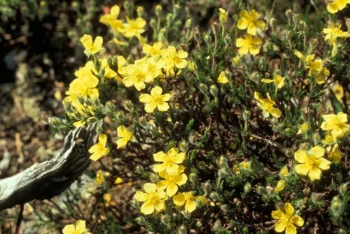
Mountain Goldenheather: A Rare Treasure of North Carolina’s Mountains
If you’ve ever wondered about the rarest plants hiding in North Carolina’s high peaks, let me introduce you to mountain goldenheather (Hudsonia montana). This tiny shrub might be small in stature, but it’s huge in conservation importance – and that’s exactly why most gardeners should admire it from afar rather than try to grow it at home.
What Makes Mountain Goldenheather Special?
Mountain goldenheather is a low-growing perennial shrub that forms dense, cushion-like mounds rarely exceeding a foot in height. Its tiny, needle-like leaves give it an almost moss-like appearance from a distance, but come spring and early summer, it bursts into bloom with small, bright yellow flowers that seem to glow against the rocky mountain landscape.
This little powerhouse belongs to the rockrose family and has adapted to some of the harshest growing conditions imaginable – think exposed granite outcrops, fierce winds, and dramatic temperature swings that would send most garden plants running for cover.
A Plant with a Very Exclusive Address
Here’s where things get really interesting (and concerning): mountain goldenheather is what botanists call an endemic species, meaning it lives in one very specific place and nowhere else on Earth. In this case, that place is the high-elevation areas of western North Carolina, particularly around Grandfather Mountain and the Blue Ridge Mountains.
- Species observed
- No observations
You won’t find this plant growing wild in any other state, country, or continent. North Carolina’s mountains are its one and only home, making it one of our state’s most geographically restricted native plants.
Why You Shouldn’t Rush to Plant It (But Should Definitely Care About It)
Before you start planning where to put mountain goldenheather in your garden, here’s the crucial information every responsible gardener needs to know: this plant is listed as Threatened in the United States and has a Global Conservation Status of S1, meaning it’s Critically Imperiled. Translation? There are typically fewer than 1,000 individuals left in the wild, scattered across just a handful of locations.
This rarity status means:
- Wild collection is absolutely off-limits and likely illegal
- Even responsibly sourced plants are extremely rare and expensive
- The species needs every individual left in the wild to survive
- Conservation efforts should take priority over cultivation
If You’re Determined to Try Growing It
While I strongly recommend supporting this plant through conservation efforts rather than cultivation, here’s what you’d need to know if you somehow obtained responsibly sourced material:
Growing Conditions: Mountain goldenheather demands full sun and extremely well-draining, acidic, sandy or rocky soil. Think alpine scree rather than garden bed. It’s adapted to USDA hardiness zones 6-7 but requires the specific microclimate conditions of high-elevation environments.
The Reality Check: Even experienced growers of alpine plants find mountain goldenheather nearly impossible to keep alive in cultivation. It’s adapted to very specific soil chemistry, drainage patterns, and exposure conditions that are difficult to replicate outside its natural habitat.
Better Ways to Support Mountain Goldenheather
Instead of trying to grow this rare beauty, consider these alternatives:
- Support conservation organizations working to protect North Carolina’s high-elevation habitats
- Visit its natural habitat respectfully (look but don’t touch or collect)
- Choose similar-looking but more common native alternatives for your garden
- Spread awareness about the importance of protecting rare endemic species
Garden-Friendly Alternatives
If you’re drawn to the low, cushion-like growth habit and small yellow flowers of mountain goldenheather, consider these more readily available native alternatives:
- Wild ginger for low groundcover in shaded areas
- Native sedums for sunny, well-draining spots
- Creeping phlox for spring color and low growth
- Native grasses that form tufted clumps
The Bigger Picture
Mountain goldenheather represents something precious in our native plant world – a species so perfectly adapted to its specific home that it can’t survive anywhere else. While this makes it nearly impossible to grow in gardens, it also makes it irreplaceably important to protect in the wild.
As native plant enthusiasts, sometimes the best thing we can do is appreciate a plant’s beauty and importance while leaving it exactly where it belongs. Mountain goldenheather is definitely one of those plants – a rare gem that’s best admired in its natural mountain home, where every individual counts toward the species’ survival.
So next time you’re hiking in North Carolina’s high country, keep your eyes peeled for this little golden treasure. Just remember: photos and memories only, please!