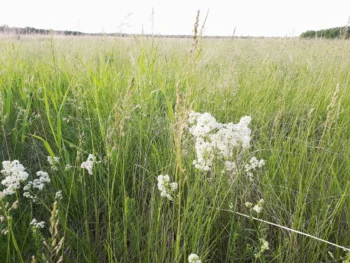
Northern Bedstraw: A Delicate Native Groundcover for Low-Maintenance Gardens
If you’re looking for a charming native plant that won’t demand constant attention, northern bedstraw (Galium boreale) might just be your new gardening companion. This unassuming perennial herb has been quietly carpeting meadows and prairies across North America for centuries, and it’s ready to bring that same effortless beauty to your landscape.
What is Northern Bedstraw?
Northern bedstraw is a native perennial forb that belongs to the coffee family. Don’t let its delicate appearance fool you—this hardy little plant is tougher than it looks. Growing up to 3 feet tall with a moderate growth rate, it forms an erect, single-crowned structure that adds subtle texture to any garden setting.
The plant produces small white flowers that bloom in late spring, creating airy clusters that seem to float above the medium-textured green foliage. While the flowers aren’t exactly show-stoppers, they have a quiet charm that’s perfect for naturalized settings.
Where Does Northern Bedstraw Grow Naturally?
This remarkable plant has one of the most impressive native ranges you’ll find. Northern bedstraw is native throughout Alaska, Canada (including Greenland), and most of the lower 48 states. You can find it thriving from the Atlantic provinces to British Columbia, and from the northern reaches of Alaska down to states like Texas and Arizona.
Its extensive distribution includes: Alberta, British Columbia, Alaska, Manitoba, New Brunswick, Arizona, California, Nova Scotia, Ontario, Colorado, Prince Edward Island, Connecticut, Quebec, Delaware, Saskatchewan, Yukon, Northwest Territories, Idaho, Illinois, Indiana, Iowa, Kentucky, Maine, Maryland, Massachusetts, Michigan, Minnesota, Missouri, Montana, Nebraska, Nevada, New Hampshire, New Jersey, New Mexico, New York, North Dakota, Ohio, Oregon, Pennsylvania, Rhode Island, South Dakota, Tennessee, Texas, Utah, Vermont, Virginia, Washington, West Virginia, Wisconsin, and Wyoming.
- Species observed
- No observations
A Note About Rarity
While northern bedstraw has a wide distribution, it’s worth noting that in New Jersey, it has a rarity status of Highlands Listed, S3, meaning it’s somewhat uncommon in that region. If you’re gardening in areas where the plant is less common, consider sourcing your plants or seeds from reputable native plant nurseries to ensure you’re supporting conservation efforts rather than depleting wild populations.
Why Grow Northern Bedstraw?
Northern bedstraw shines in low-maintenance, naturalized landscapes. Here’s why it might be perfect for your garden:
- Easy-going nature: Once established, this plant requires minimal care and has moderate drought tolerance
- Native plant benefits: Supports local ecosystems and provides habitat for native wildlife
- Pollinator support: The small white flowers attract various small pollinators including flies and beetles
- Versatile placement: Works well in prairie gardens, wildflower meadows, rock gardens, and naturalized areas
- Cold hardy: Thrives in USDA zones 2-7, making it suitable for northern climates
Perfect Garden Settings
Northern bedstraw isn’t meant for formal flower beds or manicured landscapes. Instead, it excels in:
- Prairie restorations and native plant gardens
- Wildflower meadows and naturalized areas
- Rock gardens and informal groundcover situations
- Low-maintenance landscapes where you want native plant diversity
- Areas that transition from cultivated to wild spaces
Growing Conditions and Care
One of northern bedstraw’s greatest assets is its adaptability. Here’s what it needs to thrive:
Soil Requirements
- Adapts to coarse and medium-textured soils (avoid heavy clay)
- pH range: 5.0 to 7.2
- Medium fertility requirements—no need for rich soil
- Good drainage preferred
Light and Water
- Intermediate shade tolerance (can handle some shade but prefers sun)
- Medium moisture use—not drought-loving but not water-hungry either
- Moderate drought tolerance once established
Climate Tolerance
- Extremely cold hardy (tolerates temperatures down to -33°F)
- Needs at least 85 frost-free days
- Grows well with 20-55 inches of annual precipitation
Wetland Adaptability
Northern bedstraw shows impressive flexibility when it comes to moisture conditions. Depending on your region, it can function as either a facultative upland plant (usually in drier sites but can tolerate some wetness) or a true facultative plant (equally at home in wet or dry conditions). This adaptability makes it useful for transitional areas in your landscape.
Planting and Propagation
Growing northern bedstraw from seed is your best bet, as it’s not commonly available as nursery plants except through specialized native plant suppliers. Here’s what you need to know:
- Cold stratification required: Seeds need a cold treatment to germinate properly
- High seed production: Each plant produces plenty of seeds (about 725,760 seeds per pound!)
- Self-seeding: Once established, plants will often self-seed in suitable locations
- Medium seedling vigor: Be patient—seedlings establish at a moderate pace
- Moderate spread: Plants spread at a reasonable rate, not aggressively
Maintenance and Long-term Care
The beauty of northern bedstraw lies in its low-maintenance nature:
- No regular fertilization needed
- Moderate lifespan means it will persist for several years
- Slow regrowth after cutting, so avoid frequent mowing
- Active growth period in spring and summer
- Foliage drops in winter, becoming porous
Is Northern Bedstraw Right for You?
Northern bedstraw is ideal if you’re creating naturalized spaces, working on prairie restoration, or simply want to add more native plants to your landscape without increasing your maintenance burden. It’s not the plant for formal gardens or high-impact flower displays, but it excels at providing subtle texture and supporting local ecosystems.
Consider northern bedstraw if you:
- Want to support native pollinators and wildlife
- Enjoy low-maintenance gardening
- Are creating naturalized or prairie-style landscapes
- Live in zones 2-7 and want a cold-hardy native
- Appreciate subtle, understated plant beauty
While it may not be the star of your garden show, northern bedstraw offers the quiet satisfaction of growing a plant that truly belongs in your local ecosystem—and that’s pretty special in itself.