Oak Mistletoe: The Native Parasite You Can’t Plant (But Should Appreciate)
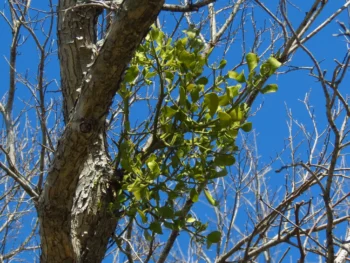
If you’ve ever spotted mysterious green clumps hanging in the bare branches of oak trees during winter, you’ve likely encountered oak mistletoe (Phoradendron leucarpum). This fascinating native plant has a lifestyle that’s quite different from your typical garden variety – it’s what we call a hemiparasite, meaning it makes its living by attaching itself to other trees. While you can’t exactly pop this one into your shopping cart at the nursery, it’s worth understanding this unique member of our native plant community.
What Exactly Is Oak Mistletoe?
Oak mistletoe is a perennial shrub that grows as a parasite on deciduous trees, particularly oaks (hence the name). Unlike the European mistletoe you might hang in doorways during the holidays, our native oak mistletoe creates distinctive, rounded clumps of yellowish-green foliage that can reach 2-3 feet across. These evergreen clusters become especially noticeable in winter when their host trees have dropped their leaves.
The plant produces small, inconspicuous flowers followed by white, translucent berries that are quite sticky – a clever adaptation that helps them stick to birds’ beaks and feet for seed dispersal.
Where You’ll Find Oak Mistletoe
This native species calls a large portion of the United States home, growing naturally across 26 states from the mid-Atlantic region down to Florida and west to Texas and Kansas. You’ll find it thriving in USDA hardiness zones 6 through 10, wherever suitable host trees are available.
- Species observed
- No observations
Why You Can’t (And Shouldn’t Try to) Grow It
Here’s where oak mistletoe gets interesting from a gardener’s perspective – you simply can’t plant it in the traditional sense. As a parasitic plant, it requires a living host tree to survive, drawing water and nutrients through specialized root-like structures called haustoria that penetrate the host’s bark.
Even if you wanted to introduce oak mistletoe to your landscape, it’s not something you can purchase or propagate easily. The seeds need to be dispersed by birds and must land on suitable branches of the right host species to have any chance of establishment.
The Ecological Role of Oak Mistletoe
While oak mistletoe might seem like a freeloader, it actually plays several important ecological roles:
- Provides winter food for birds through its berries
- Creates nesting sites and shelter for various bird species
- Adds structural diversity to forest canopies
- Supports specialized insects and other wildlife
The relationship between mistletoe and its host is generally not harmful when present in moderate amounts, though heavy infestations can stress trees.
A Note on Conservation Status
Interestingly, oak mistletoe has a special conservation status in New Jersey, where it’s listed as Pinelands with an S4 ranking, indicating it’s apparently secure but with some cause for long-term concern. This designation means that while you can’t cultivate it yourself, it’s worth protecting existing populations and the oak forests that support them.
What This Means for Your Garden
Instead of trying to grow oak mistletoe directly, the best thing you can do as a native plant gardener is:
- Plant native oak species that can serve as hosts
- Maintain healthy, mature trees in your landscape
- Avoid removing mistletoe unless it’s severely damaging a valuable tree
- Appreciate it as part of your local ecosystem when you encounter it
The Bottom Line
Oak mistletoe represents one of nature’s more unusual relationships – a native plant that’s perfectly adapted to life in the treetops but completely unsuitable for your perennial border. While you can’t add it to your garden wish list, you can appreciate its ecological importance and support it by maintaining the oak-dominated forests and landscapes where it naturally occurs. Sometimes the best way to garden with native plants is simply to let nature do its thing!