Rock Clubmoss: A Prehistoric Plant That’s Harder to Grow Than You’d Think
Meet rock clubmoss (Huperzia porophila), one of nature’s living fossils that’s been around since before dinosaurs walked the earth. This isn’t your typical garden plant – in fact, it’s not even technically a moss at all! Rock clubmoss belongs to an ancient group of plants called lycopods, making it more closely related to ferns than to the mosses it resembles.
What Exactly Is Rock Clubmoss?
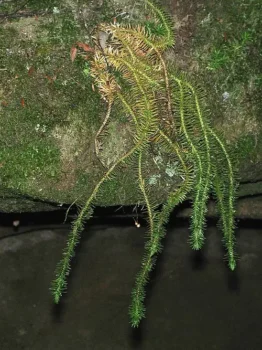
Rock clubmoss is a perennial lycopod that looks like a tiny, upright evergreen tree shrunk down to just a few inches tall. Instead of flowers and seeds, this prehistoric plant reproduces through spores, just like its ancestors did hundreds of millions of years ago. Its small, scale-like leaves spiral around branching stems, creating a delicate, moss-like texture that gives the plant its common name.
Don’t let the word moss fool you – this is actually a vascular plant with specialized tissues for moving water and nutrients, unlike true mosses. Think of it as nature’s bonsai tree, complete with its own tiny root system.
Where Does Rock Clubmoss Call Home?
Rock clubmoss is native to both Canada and the eastern United States, naturally occurring across a surprisingly wide range. You can find it growing wild in Alabama, Georgia, Illinois, Indiana, Iowa, Kentucky, Maryland, Minnesota, Missouri, New Jersey, North Carolina, Ohio, Ontario, Pennsylvania, South Carolina, Tennessee, Vermont, Virginia, West Virginia, and Wisconsin.
- Species observed
- No observations
However, don’t let this extensive range fool you into thinking it’s common everywhere. In Alabama, rock clubmoss has a rarity status of S1, meaning it’s critically rare in that state.
Is Rock Clubmoss Beneficial in Gardens?
Here’s where things get interesting – and a bit challenging. Rock clubmoss can add a unique, prehistoric charm to specialized garden settings, but it’s notoriously difficult to establish and maintain in typical garden conditions. Here’s what you need to know:
The Good News:
- Adds incredible textural interest with its primitive, moss-like appearance
- Perfect for creating authentic woodland or rock garden settings
- Conversation starter – few plants have such an ancient lineage
- Low maintenance once established (if you can get it established)
The Reality Check:
- Extremely specific growing requirements that are hard to replicate
- Slow growing and difficult to propagate
- Rare in some areas, making ethical sourcing a concern
- Not suitable for typical garden beds or landscaping projects
Growing Conditions and Requirements
Rock clubmoss is quite particular about where it wants to live. In the wild, you’ll typically find it in cool, moist, shaded areas with well-draining, acidic soil. It shows different moisture preferences depending on the region – in coastal areas, it strongly prefers upland sites that stay relatively dry, while in mountainous and northern regions, it can tolerate some wetland conditions.
The plant thrives in USDA hardiness zones 3-7, preferring:
- Filtered to deep shade
- Consistently cool temperatures
- Well-draining, acidic soil
- Rocky or sandy substrates
- High humidity but not waterlogged conditions
How to Identify Rock Clubmoss
If you’re lucky enough to spot rock clubmoss in the wild, here’s what to look for:
- Small, upright stems that branch irregularly
- Tiny, scale-like leaves arranged spirally around the stems
- Overall height typically 2-6 inches tall
- Bright to dark green coloration
- Growing in small colonies in shaded, rocky areas
- No flowers – instead, look for small spore-bearing structures
A Word of Caution About Sourcing
Given rock clubmoss’s rarity in some areas and its difficulty to cultivate, we strongly recommend against collecting it from the wild. If you’re determined to try growing this prehistoric beauty, only source plants from reputable native plant nurseries that can guarantee their stock was responsibly propagated, not wild-collected.
Honestly, unless you’re a dedicated specialist in native plants or have the perfect microclimate, you might be better off appreciating rock clubmoss in its natural habitat rather than attempting to grow it in your garden.
The Bottom Line
Rock clubmoss is undeniably fascinating – a living link to Earth’s ancient past that adds incredible character to the right garden setting. However, its finicky nature and conservation concerns make it a plant best left to expert growers or enjoyed in its natural habitat. If you’re looking for easier-to-grow native alternatives that provide similar textural interest, consider native sedges, small ferns, or other shade-loving groundcovers that will be much more forgiving of typical garden conditions.
Sometimes the most beautiful plants are the ones we admire from a respectful distance, and rock clubmoss might just be one of them.