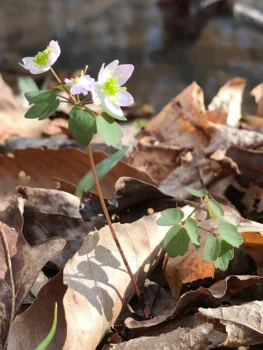
Rue Anemone: The Woodland Charmer That Kicks Off Spring
If you’re looking for a native wildflower that delivers delicate beauty right when your garden is waking up from winter’s slumber, rue anemone (Thalictrum thalictroides) might just be your new best friend. This charming little perennial is one of those wonderful spring ephemerals that appears early, puts on a lovely show, and then gracefully steps back to let other plants take center stage.
What Makes Rue Anemone Special?
Rue anemone earns its place in the garden with dainty white flowers that seem to float above delicate, blue-green foliage. Each bloom features 5 to 10 petal-like sepals (they’re not actually petals, but who’s counting?) that dance in the slightest breeze. The flowers typically appear in March through May, depending on your location, making this plant a welcome sight after months of bare ground.
You might also encounter this plant under its former scientific names, Anemonella thalictroides or Syndesmon thalictroides, if you’re browsing older gardening references or plant databases.
Where Rue Anemone Calls Home
This native beauty has quite an impressive natural range, stretching across much of eastern North America. You’ll find wild populations from southeastern Canada down through the eastern United States, including Alabama, Arkansas, Connecticut, Delaware, Florida, Georgia, Illinois, Indiana, Iowa, Kansas, Kentucky, Maine, Maryland, Massachusetts, Michigan, Minnesota, Mississippi, Missouri, New Hampshire, New Jersey, New York, North Carolina, Ohio, Oklahoma, Pennsylvania, Rhode Island, South Carolina, Tennessee, Texas, Vermont, Virginia, West Virginia, and Wisconsin, plus Ontario, Canada.
- Species observed
- No observations
Why Your Garden (and Local Wildlife) Will Love It
Rue anemone isn’t just a pretty face – it’s a hardworking member of the native plant community. As one of the earliest bloomers, it provides crucial nectar for native bees, small butterflies, and beneficial flies when few other flowers are available. Think of it as opening the seasonal buffet for your local pollinators.
From a design perspective, rue anemone shines in:
- Woodland gardens where it can naturalize under trees
- Shade gardens that need early spring interest
- Native plant landscapes focused on regional flora
- Rock gardens with dappled shade
Growing Rue Anemone Successfully
The good news? Rue anemone is refreshingly low-maintenance once you understand its preferences. This woodland native thrives in partial to full shade – think of the dappled light you’d find under deciduous trees in its natural habitat.
Ideal Growing Conditions
Give your rue anemone:
- Light: Partial to full shade (morning sun is fine)
- Soil: Moist, well-draining soil rich in organic matter
- Hardiness: Zones 4-8, so it’s quite adaptable to different climates
- Moisture: Consistent moisture in spring, can tolerate some summer dryness
Regarding wetland conditions, rue anemone is pretty flexible. It typically prefers upland conditions but can adapt to occasional wet periods, making it versatile for various garden situations.
Planting and Care Tips
Plant rue anemone in fall or early spring, giving each plant about 6-12 inches of space. The tuberous roots will gradually spread to form colonies, but don’t worry – it’s not aggressive about it.
Here’s the thing about spring ephemerals like rue anemone: they have their own schedule. After blooming, the foliage will persist for several weeks, then gradually die back as summer heats up. This isn’t a problem – it’s just their natural rhythm. They’re storing energy in their roots for next year’s show.
Care is minimal:
- Water regularly during the growing season
- Add compost or leaf mold annually to enrich the soil
- Leave the foliage alone until it naturally yellows and dies back
- Mark the location if you’re concerned about forgetting where it’s planted during dormancy
Is Rue Anemone Right for Your Garden?
Rue anemone is perfect if you want a native plant that:
- Provides early spring beauty without being fussy
- Supports local wildlife and pollinators
- Fits naturally into woodland or shade garden settings
- Won’t take over your garden (it spreads slowly and politely)
Keep in mind that this is a spring ephemeral, so you’ll want companion plants to fill in after it goes dormant. Wild ginger, ferns, or later-blooming woodland plants make excellent partners.
With its delicate beauty, native credentials, and easy-going nature, rue anemone proves that sometimes the most charming garden residents are the ones that know how to make a graceful entrance – and an equally graceful exit.