Small Whorled Pogonia: A Rare Native Orchid Worth Protecting (But Not Planting)
If you’ve stumbled upon information about the small whorled pogonia (Isotria medeoloides), you might be wondering if this native North American orchid could grace your garden. Here’s the short answer: it absolutely should not. But before you click away, let me tell you why this remarkable little plant deserves our attention and protection, even if we can’t grow it ourselves.
What Makes Small Whorled Pogonia Special?
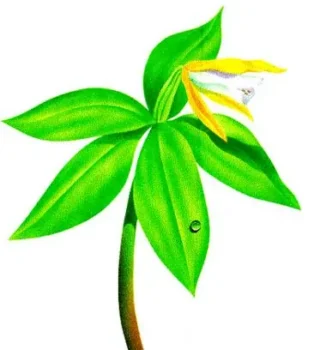
The small whorled pogonia is a perennial forb—essentially a non-woody plant that comes back year after year. What makes it truly distinctive is its unique appearance: a single stem topped with a whorl of 5-6 pale green leaves arranged like the spokes of an umbrella, with delicate yellowish-green flowers emerging from the center. It’s like nature’s own little parasol, standing quietly in the forest understory.
Where Does It Call Home?
This native beauty has quite an extensive range across eastern North America, from Ontario down to Georgia. You can find it (or rather, you could find it if you were incredibly lucky) in states including Connecticut, Delaware, Georgia, Illinois, Maine, Maryland, Massachusetts, Michigan, Missouri, New Hampshire, New Jersey, New York, North Carolina, Ohio, Pennsylvania, Rhode Island, South Carolina, Tennessee, Vermont, Virginia, and West Virginia.
- Species observed
- No observations
The Critical Reality: Why You Shouldn’t Plant It
Here’s where things get serious. Small whorled pogonia isn’t just uncommon—it’s genuinely rare and protected. The plant holds a federal Threatened status under the Endangered Species Act, and in New Jersey, it’s listed as Endangered. With a global conservation status that reflects significant concern for its survival, this orchid is fighting for its existence in the wild.
Even if you could somehow obtain seeds or plants (which would likely be illegal), attempting to grow small whorled pogonia would be:
- Potentially illegal due to its protected status
- Practically impossible without the specific forest ecosystem it requires
- Ethically questionable when wild populations need every individual to survive
Understanding Its Habitat Needs
Small whorled pogonia has very specific growing requirements that make home cultivation nearly impossible. It typically grows in mature deciduous and mixed forests, preferring areas that are facultative upland—meaning it usually occurs in non-wetland areas but can occasionally be found in wetland edges. The plant requires complex relationships with soil fungi (mycorrhizae) that are nearly impossible to replicate in a garden setting.
Based on its natural range, it likely thrives in USDA hardiness zones 3-8, but its habitat requirements go far beyond simple temperature tolerance.
How You Can Help Instead
While you can’t grow small whorled pogonia in your garden, you can support its conservation in meaningful ways:
- Support organizations that protect native plant habitats
- Choose native alternatives for your garden that support local ecosystems
- Participate in citizen science programs that help track rare plant populations
- Advocate for habitat protection in your area
Native Alternatives for Your Garden
If you’re drawn to native orchids or woodland plants with similar appeal, consider these more garden-friendly alternatives:
- Wild ginger (Asarum canadense) for interesting foliage patterns
- Trilliums for woodland charm
- Native ferns for delicate forest floor aesthetics
- Showy orchis (where appropriate and available from ethical sources)
The Bigger Picture
Small whorled pogonia serves as a reminder that not every beautiful native plant belongs in our gardens. Sometimes, the best way to appreciate and protect these botanical treasures is to leave them where they belong—in their natural habitats, where they can continue their ancient relationships with the forest ecosystem.
By understanding and respecting the conservation needs of rare plants like small whorled pogonia, we become better stewards of our native flora. And that’s something every gardener can feel good about, even if it means admiring this particular beauty from afar.