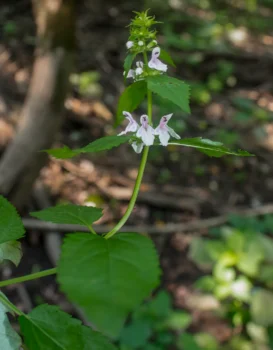
Smooth Hedgenettle: A Native Wildflower Worth Discovering
If you’re looking for a native perennial that’s both beautiful and beneficial, let me introduce you to smooth hedgenettle (Stachys tenuifolia). This unassuming wildflower might not be the flashiest plant in your garden, but it’s definitely one of the hardest workers, especially when it comes to supporting local wildlife and thriving in challenging conditions.
What Is Smooth Hedgenettle?
Smooth hedgenettle is a native North American perennial that belongs to the mint family. True to its family heritage, it produces lovely purple flowers arranged in distinctive whorled spikes that bloom from late spring into summer. As a forb (a non-woody flowering plant), it reaches about 2 feet tall and forms clumps through its single crown growth pattern.
This plant is a true native success story, naturally occurring across a vast range from southern Canada down to the Gulf Coast states. You’ll find it growing wild in an impressive 41 states and several Canadian provinces, making it one of our more widespread native species.
Where Does It Grow Naturally?
Smooth hedgenettle has an extensive natural range across eastern and central North America. It thrives from the Maritime provinces of Canada all the way down to Florida and Texas, and from the Atlantic coast west to the Great Plains. This wide distribution speaks to its adaptability and resilience.
- Species observed
- No observations
A Note About Rarity
While smooth hedgenettle is widespread across its range, it’s worth noting that in New Jersey, this species has a rarity status of S3 (vulnerable). If you live in areas where the plant may be less common, please source your plants or seeds from reputable native plant nurseries that practice ethical collection methods.
Why Grow Smooth Hedgenettle?
There are several compelling reasons to consider adding this native beauty to your landscape:
- Pollinator magnet: The purple flower spikes are irresistible to bees, butterflies, and other beneficial insects
- Low maintenance: Once established, it’s quite self-sufficient
- Adaptable: Tolerates a wide range of soil types and moisture conditions
- Native heritage: Supports local ecosystems and wildlife
- Wetland friendly: Excellent for rain gardens and naturally wet areas
Perfect Garden Situations
Smooth hedgenettle shines in several garden scenarios:
- Native plant and pollinator gardens
- Rain gardens and bioswales
- Naturalized woodland edges
- Low-maintenance landscape areas
- Wetland restoration projects
It’s particularly valuable in areas that stay consistently moist, as this plant has different wetland statuses across regions – from facultative wetland (usually in wet areas but can handle drier spots) to obligate wetland (almost always needs wet conditions) in the Midwest.
Growing Conditions and Care
One of smooth hedgenettle’s best qualities is its easy-going nature. Here’s what it prefers:
Soil: Adaptable to coarse, medium, and fine-textured soils with a pH between 5.7 and 7.4. It has high moisture requirements, so don’t let it dry out completely.
Light: Shade tolerant, meaning it can handle partial shade to full sun conditions.
Hardiness: Thrives in USDA zones 3-8, handling temperatures as low as -33°F.
Water: High moisture use – this plant loves consistent water and can handle poorly drained soils better than drought.
Planting and Care Tips
Getting smooth hedgenettle established is refreshingly straightforward:
- Propagation: Easily grown from seed (157,000 seeds per pound!) or sprigs
- Planting density: Space plants to achieve 1,200-1,700 plants per acre for natural plantings
- Growth rate: Moderate growth with medium seedling vigor
- Maintenance: Cut back after flowering if desired, though the plant doesn’t resprout readily
- Spreading: Won’t take over your garden – it has no vegetative spreading ability
Seasonal Care: This perennial is active during spring and summer, with slow regrowth after any cutting. The foliage isn’t particularly showy in fall, and the plant doesn’t retain its leaves through winter.
The Bottom Line
Smooth hedgenettle might not be the showiest plant in your garden, but it’s definitely one of the most reliable native options for wet or consistently moist areas. Its purple flower spikes provide crucial nectar for pollinators, and its adaptable nature makes it perfect for gardeners who want beautiful, low-maintenance native plants.
If you’re creating a rain garden, restoring a wetland area, or simply want to support native pollinators with a plant that won’t require constant attention, smooth hedgenettle deserves a spot on your planting list. Just remember to source it responsibly, especially in areas where it might be less common.