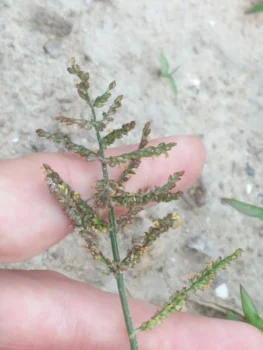
Native Plants

Sprawling Signalgrass

Urochloa reptans

USDA symbol: URRE2

annual grass

Lower 48 states: non-native, naturalized
Pacific Basin excluding Hawaii: native
Puerto Rico: non-native, naturalized
U.S. Virgin Islands: non-native, naturalized

If you’re looking for a low-maintenance ground cover that can handle tough conditions, you might have stumbled across sprawling signalgrass (Urochloa reptans). This prostrate grass has quite the collection of botanical aliases – you might also see it listed as Brachiaria reptans, Panicum prostratum, or Panicum reptans. But before you ...

Sprawling Signalgrass: A Ground-Hugging Grass with Mixed Appeal

If you’re looking for a low-maintenance ground cover that can handle tough conditions, you might have stumbled across sprawling signalgrass (Urochloa reptans). This prostrate grass has quite the collection of botanical aliases – you might also see it listed as Brachiaria reptans, Panicum prostratum, or Panicum reptans. But before you decide whether this sprawling character belongs in your landscape, let’s dig into what makes it tick.

What Is Sprawling Signalgrass?

Sprawling signalgrass is exactly what its name suggests – a grass that likes to sprawl. This annual to perennial graminoid (that’s botanist-speak for grass-like plant) grows low to the ground, spreading outward rather than reaching for the sky. Think of it as the ground-hugging cousin in the grass family tree.

Where You’ll Find It Growing

Here’s where things get interesting: sprawling signalgrass isn’t originally from around these parts. It’s native to the Pacific Basin (though not Hawaii), but has made itself at home across several southern U.S. states including Alabama, Florida, Louisiana, Maryland, and Texas. You’ll also find it established in Guam, Palau, Puerto Rico, and the Virgin Islands.

  • Species observed
  • No observations

This grass has proven quite the traveler, reproducing on its own in the wild without any help from gardeners. It’s what botanists call naturalized – not native, but not going anywhere either.

Growing Conditions and Hardiness

One thing sprawling signalgrass has going for it is adaptability. This grass is classified as Obligate Upland in most regions, meaning it almost never occurs in wetlands – it prefers well-drained, drier soils. The exception is Hawaii, where it can handle both wet and dry conditions.

Based on its current distribution, sprawling signalgrass appears to thrive in USDA hardiness zones 8-11, making it suitable for warmer climates. It’s quite drought-tolerant once established and can handle poor soils that might challenge other plants.

Should You Plant Sprawling Signalgrass?

This is where gardeners need to weigh the pros and cons:

The Good:

  • Excellent for erosion control on slopes
  • Low maintenance once established
  • Drought tolerant
  • Adapts to poor soils
  • Forms dense ground cover

The Not-So-Good:

  • Non-native species
  • Can spread aggressively
  • Limited wildlife and pollinator benefits
  • May outcompete native plants

Native Alternatives to Consider

Since sprawling signalgrass isn’t native to most areas where it’s now found, you might want to consider these native ground cover grasses instead:

  • Buffalo grass (Bouteloua dactyloides) for drier regions
  • Curly mesquite (Hilaria belangeri) for southwestern areas
  • Seashore paspalum (Paspalum vaginatum) for coastal regions

These natives will provide similar ground cover benefits while supporting local ecosystems and wildlife.

If You Do Decide to Grow It

Should you choose to plant sprawling signalgrass, here’s what you need to know:

  • Plant in full sun for best growth
  • Ensure good drainage – this grass doesn’t like wet feet
  • Be prepared to manage its spread
  • Water regularly until established, then reduce watering
  • Consider installing barriers to prevent unwanted spreading

The Bottom Line

Sprawling signalgrass can be useful for specific situations like erosion control or low-maintenance ground cover in challenging sites. However, as a non-native species, it’s worth considering whether a native alternative might better serve both your landscape goals and local ecosystems. Whatever you choose, make sure it’s the right fit for your garden’s needs and your region’s environmental health.

Urochloa reptans is also known as...

Often we refer to plants by their common names. When shopping for plants the scientific name is the best way to positively identify the plant species you desire. But some plants have more than one name! While it doesn't happen often, nurseries might display one name while you're searching for another. Urochloa reptans is also known as:

Brachiaria reptans & | USDA symbol: BRRE
Panicum prostratum | USDA symbol: PAPR9
Panicum reptans | USDA symbol: PARE9

Why do some plants have more than one name? Over time plant species may be renamed for a few reasons:

  1. Botanists in different regions named the same plant without knowing it had already been classified.
  2. A species was reclassified after scientific advances in, for example, DNA analysis.
  3. Slight variations within a species are sometimes mistakenly identified as entirely new species.

Wetland Status

The rule of seasoned gardeners and landscapers is to choose the "right plant for the right place" — matching plants to their ideal growing conditions, so they'll thrive with less care and fewer inputs. But the simplicity of this catchphrase conceals how tricky plant selection can be if you don't have the right information. While tags on nursery plants list watering requirements, there's more to the story.

Knowing a plant's wetland status can simplify the process by revealing the interaction between plants, water, and soil. You might be surprised to learn that popular landscape plants are wetland species! And what may be a wetland plant in one area, in another it might thrive in drier conditions. The table below gives insight into the preferred growing conditions of this plant throughout its geographical distribution.

Region
Preferred Habitat

Atlantic and Gulf Coastal Plain (AL, AR, DC, DE, FL, GA, IL, KY, LA, MD, MS, MO, NC, NJ, OK, PA, SC, TN, TX, VA)

Obligate Upland

Caribbean (PR, VI)

Obligate Upland

Eastern Mountains and Piedmont (AL, AR, DC, DE, GA, IL, IN, KS, KY, MD, MO, NC, NJ, NY, OH, OK, PA, SC, TN, VA, WV)

Obligate Upland

Great Plains (CO, KS, MN, MT, NE, NM, ND, OK, SD, TX, WY)

Obligate Upland

Hawaii ()

Facultative
Wetland Glossary
Obligate Wetland
Facultative Wetland
Facultative
Facultative Upland
Obligate Upland
Almost always occurs in wetlands
Usually occurs in wetlands but may occur in non-wetlands
Can occur in wetlands and non-wetlands
Usually occurs in non-wetlands but may occur in wetlands
Almost never occurs in wetlands

Classification

Group: Monocot
Kingdom: Plantae - Plants
Subkingdom: Tracheobionta - Vascular plants
Superdivision: Spermatophyta - Seed plants
Division: Magnoliophyta - Flowering plants
Class: Liliopsida - Monocotyledons
Subclass: Commelinidae
Order: Cyperales
Family: Poaceae Barnhart - Grass family
Genus: Urochloa P. Beauv. - signalgrass

Species: Urochloa reptans (L.) Stapf - sprawling signalgrass

Plant data source: USDA, NRCS 2025. The PLANTS Database. https://plants.usda.gov,. 2/25/2025. National Plant Data Team, Greensboro, NC USA