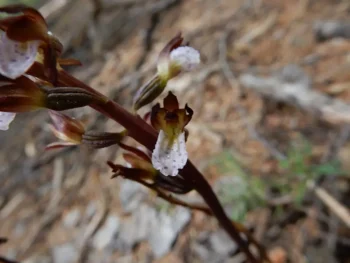
Spring Coralroot: The Mysterious Orchid You Probably Shouldn’t Try to Grow
Meet spring coralroot (Corallorhiza wisteriana), one of North America’s most enigmatic native orchids. This perennial forb might not win any beauty contests in your typical flower garden, but it’s absolutely fascinating for what it represents in the wild. Before you get any ideas about adding this unusual plant to your landscape, though, let’s talk about why this particular native might be better admired from afar.
What Makes Spring Coralroot So Special?
Spring coralroot is what botanists call a parasitic orchid, and it’s as mysterious as it sounds. Unlike most plants that photosynthesize their own food, this clever little orchid has given up on green leaves entirely. Instead, it taps into underground fungal networks to get its nutrients—essentially living off the fungi that form partnerships with tree roots. It’s like nature’s version of freeloading, but in the most sophisticated way possible!
When spring coralroot does make an appearance above ground, it sends up yellowish-brown to purplish stems that reach about 4 to 16 inches tall. Don’t expect showy flowers—these small, inconspicuous blooms are more about function than form. The entire plant has an otherworldly appearance that makes it look more like something from a fairy tale than a typical garden flower.
Where Does Spring Coralroot Call Home?
This native orchid has quite the impressive range across the lower 48 states. You can find spring coralroot growing naturally in an astounding 35 states, from Alabama and Florida in the Southeast, all the way to Montana and Oregon in the West, and everywhere from New Hampshire to Texas in between. It’s truly a coast-to-coast native that has adapted to a wide variety of climates and forest types.
- Species observed
- No observations
The Rarity Reality Check
Here’s where things get serious: spring coralroot is considered rare in several states. In Alabama, it has a rarity status of S2, meaning it’s imperiled due to a restricted range, few populations, or other factors. In New Jersey, it’s listed as SX in the Highlands region, which indicates it’s presumed extinct. These designations should make us pause and think carefully about our relationship with this plant.
Why You Shouldn’t Try Growing Spring Coralroot
While spring coralroot is undeniably native and ecologically important, it’s not a plant for the home garden. Here’s why:
- Extremely specialized needs: This orchid requires specific mycorrhizal fungi partners that are nearly impossible to replicate in cultivation
- Conservation concerns: With its rare status in multiple states, removing plants from the wild or attempting propagation could harm wild populations
- Poor garden performance: Even if you could establish the right fungal relationships, the plant offers little aesthetic value for typical landscaping
- Unpredictable appearance: Spring coralroot may not emerge above ground every year, making it an unreliable garden addition
Appreciating Spring Coralroot Responsibly
Instead of trying to grow spring coralroot, consider these alternatives:
- Support habitat conservation: Protect the mature forests where spring coralroot naturally occurs
- Choose garden-friendly native orchids: Look for more adaptable native orchids like wild ginger or native lady slippers that are easier to establish
- Create mycorrhizal-friendly gardens: Plant native trees and shrubs that support the fungal networks that orchids like spring coralroot depend on
- Participate in citizen science: Help document wild populations through photography and reporting to local botanical organizations
The Bigger Picture
Spring coralroot might not be destined for your garden border, but it plays a crucial role in forest ecosystems across North America. Its presence indicates healthy, mature forest systems with intact fungal networks—something increasingly rare in our fragmented landscape. By understanding and respecting plants like spring coralroot, we become better stewards of the complex web of relationships that make native ecosystems function.
So the next time you’re hiking through a mature forest and spot what looks like a small, leafless brown stem with tiny flowers, take a moment to appreciate the spring coralroot. It’s a reminder that some of nature’s most fascinating adaptations are also some of the most fragile, and sometimes the best way to love a native plant is to leave it exactly where it belongs.