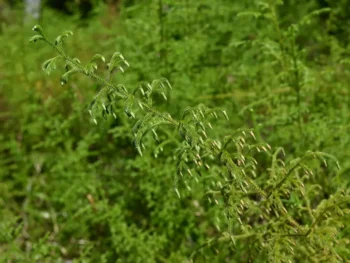
Staghorn Clubmoss: A Living Fossil for Your Wetland Garden
Meet the staghorn clubmoss (Lycopodiella cernua), a fascinating little plant that’s been around since before dinosaurs walked the earth! This isn’t your typical garden flower or shrub – it’s a lycopod, one of the most ancient plant groups on our planet. If you’re looking to add something truly unique to your landscape, this primitive beauty might just be the conversation starter you never knew you needed.
What Exactly Is Staghorn Clubmoss?
Don’t let the name fool you – staghorn clubmoss isn’t actually a moss at all! It’s a lycopod, which means it’s more closely related to ferns than to true mosses. This perennial herb gets its common name from its distinctive branching pattern that resembles tiny deer antlers. The plant forms low-growing mats or small clumps, creating an almost prehistoric carpet across suitable habitats.
Unlike flowering plants, staghorn clubmoss reproduces through spores rather than seeds, making it a living link to Earth’s ancient past. In Palau, it’s known as olcheiulabeab, highlighting its widespread Pacific distribution.
Where Does It Call Home?
This remarkable plant is native across an impressive range, including the southeastern United States, Hawaii, Puerto Rico, the U.S. Virgin Islands, and various Pacific islands. You can find it naturally growing in Alabama, Arkansas, Florida, Georgia, Hawaii, Louisiana, Mississippi, South Carolina, Texas, as well as in Guam, Palau, Puerto Rico, and the Virgin Islands.
- Species observed
- No observations
However, there’s an important caveat for potential growers: staghorn clubmoss has a rare status (S1S2) in Alabama, meaning it’s quite uncommon there. If you’re considering adding this plant to your collection, please ensure you source it responsibly from reputable nurseries rather than wild-collecting.
Is It Right for Your Garden?
Staghorn clubmoss thrives in USDA hardiness zones 8-11, making it suitable for warmer climates. This isn’t a plant for your typical perennial border – it’s a specialist that demands specific conditions to flourish.
Best suited for:
- Bog gardens and wetland plantings
- Native plant collections
- Educational or botanical gardens
- Specialized habitat restoration projects
Growing Conditions and Care
If you’re up for the challenge, staghorn clubmoss requires consistently moist to wet, acidic soils. Think swampy conditions rather than your average garden bed! It can tolerate partial shade to full sun, but moisture is absolutely critical.
Fair warning: this isn’t a beginner plant. Establishing lycopods can be tricky, and they’re quite particular about their growing conditions. Success requires patience and the right habitat – you can’t simply plop this in any old garden spot and expect it to thrive.
Benefits to Your Garden Ecosystem
While staghorn clubmoss won’t attract pollinators like flowering plants do (remember, it reproduces via spores!), it offers other unique benefits:
- Creates habitat diversity in wetland gardens
- Provides educational value as a living fossil
- Supports the overall ecosystem of bog and wetland environments
- Offers year-round interest with its distinctive form
How to Identify Staghorn Clubmoss
Look for these key characteristics:
- Low-growing, mat-forming habit
- Distinctive forked, antler-like branching
- Small, scale-like leaves along the stems
- Sporangia (spore-bearing structures) at branch tips
- Preference for wet, acidic soils
The Bottom Line
Staghorn clubmoss isn’t for everyone, and that’s perfectly okay! This specialized plant requires specific wetland conditions and careful attention to thrive. If you have the right habitat and a passion for unique, ancient plants, it can be a fascinating addition to your landscape. However, if you’re looking for low-maintenance ground cover or don’t have consistently wet conditions, you might want to consider other native alternatives better suited to typical garden settings.
Remember, if you do decide to grow this living fossil, source it responsibly and give it the swampy conditions it craves. Your efforts will be rewarded with a truly unique plant that connects your garden to millions of years of natural history!