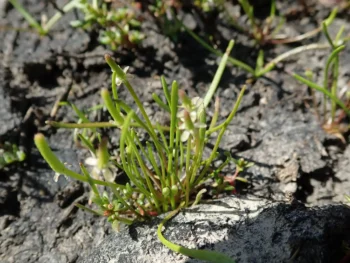
Tiny Mousetail: A Diminutive Native with Specialized Needs
If you’ve ever wondered about the smallest flowering plants in North America, meet tiny mousetail (Myosurus minimus) – a petite annual that lives up to its common name in every way. This unassuming native forb might not win any beauty contests, but it plays an interesting role in North America’s wetland ecosystems.
What is Tiny Mousetail?
Tiny mousetail is an annual forb native to both Canada and the lower 48 United States. As a forb, it’s a non-woody vascular plant that completes its entire life cycle in a single growing season. Don’t expect this plant to make a dramatic statement in your garden – it typically reaches only about 4 inches tall and produces small, inconspicuous green flowers during mid-spring.
Where Does Tiny Mousetail Grow?
This little plant has an impressively wide distribution across North America. You can find it growing naturally in states from coast to coast, including Alabama, Arizona, California, Colorado, Delaware, Georgia, Idaho, Illinois, Indiana, Iowa, Kansas, Kentucky, Louisiana, Massachusetts, Minnesota, Mississippi, Missouri, Montana, Nebraska, New Mexico, North Carolina, North Dakota, Ohio, Oklahoma, Oregon, Pennsylvania, South Carolina, South Dakota, Tennessee, Texas, Utah, Virginia, Washington, Wisconsin, and Wyoming. In Canada, it grows in Alberta, British Columbia, Manitoba, Ontario, and Saskatchewan.
- Species observed
- No observations
Should You Plant Tiny Mousetail in Your Garden?
Here’s where things get interesting – and honest. While tiny mousetail is undeniably native and ecologically authentic, it’s not what most gardeners would consider ornamentally appealing. This plant is:
- Extremely small (under 5 inches tall)
- Short-lived (annual that dies after setting seed)
- Inconspicuous (green flowers that most people won’t notice)
- Specialized in its needs (requires consistently moist to wet conditions)
Best suited for: Naturalistic gardens, restoration projects, rain gardens, or seasonal wetland areas where you want to support native biodiversity rather than create visual impact.
Not ideal for: Traditional flower beds, drought-tolerant landscapes, or anywhere you want reliable, showy blooms.
Tiny Mousetail’s Wetland Connection
One of the most important things to understand about tiny mousetail is its strong association with wet conditions. Its wetland status varies by region:
- Arid West and Western Mountains: Obligate wetland (almost always in wetlands)
- Most other regions: Facultative wetland (usually in wetlands but can occur elsewhere)
- Northcentral & Northeast: Facultative (can occur in both wet and dry areas)
This means that in most areas, you’ll need consistently moist to wet soil conditions for this plant to thrive.
Growing Conditions and Care
If you decide to try growing tiny mousetail, here’s what it needs:
- Soil: Adapts to medium and fine-textured soils; pH range of 5.2-7.5
- Moisture: Medium to high moisture requirements; low drought tolerance
- Light: Intermediate shade tolerance (can handle some shade)
- Temperature: Minimum 52°F; needs at least 80 frost-free days
- Hardiness: Suitable for zones 3-9 based on its wide distribution
Propagation and Availability
Here’s the challenge: tiny mousetail has no known commercial availability. If you want to grow it, you’ll need to:
- Collect seeds responsibly from wild populations (where legally permitted)
- Sow seeds directly in spring – they don’t require cold stratification
- Expect moderate germination and seedling vigor
- Allow plants to self-seed for future populations
With approximately 175,000 seeds per pound, a little goes a long way!
Wildlife and Pollinator Benefits
While specific wildlife benefits aren’t well-documented, as a native annual forb, tiny mousetail likely provides some value to local ecosystems. However, due to its very small, green flowers, it’s probably not a significant pollinator plant. The seeds may provide food for small birds or other wildlife.
The Bottom Line
Tiny mousetail is a fascinating example of North America’s native plant diversity, but it’s definitely a specialist rather than a generalist garden plant. Consider it if you’re creating naturalistic wetland gardens, working on restoration projects, or simply want to support the full spectrum of native biodiversity – just don’t expect it to be the star of your flower border!
For most gardeners seeking native alternatives with more visual impact, consider other moisture-loving natives like cardinal flower, swamp milkweed, or native sedges that offer both ecological benefits and garden appeal.