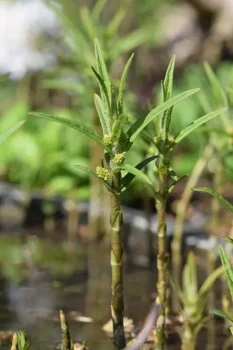
Tufted Loosestrife: A Native Wetland Gem for Your Water Garden
If you’ve been searching for the perfect native plant to fill that perpetually soggy spot in your yard, meet tufted loosestrife (Lysimachia thyrsiflora). This unassuming perennial might not win any beauty contests, but it’s exactly what your wetland garden has been waiting for. Think of it as the reliable friend who’s always there when you need them – not flashy, but absolutely dependable.
What Exactly Is Tufted Loosestrife?
Tufted loosestrife is a native North American perennial that belongs to the primrose family. Despite its common name, it’s not related to the infamous purple loosestrife that gardeners love to hate. This plant is a true native with an impressive pedigree, naturally occurring across a vast range from Alaska to the Maritime provinces and down through much of the continental United States.
You might also encounter this plant listed under its scientific synonym, Naumburgia thyrsiflora, in older botanical references. But don’t let the name confusion fool you – it’s the same wonderful wetland plant.
Where Does It Call Home?
Tufted loosestrife has one of the most extensive native ranges you’ll find in North American plants. It grows naturally in Alberta, British Columbia, Alaska, Manitoba, New Brunswick, Nova Scotia, Ontario, Prince Edward Island, Quebec, Saskatchewan, Yukon, Northwest Territories, Labrador, and Newfoundland. In the United States, you can find it thriving in California, Colorado, Connecticut, Idaho, Illinois, Indiana, Iowa, Kansas, Maine, Maryland, Massachusetts, Michigan, Minnesota, Missouri, Montana, Nebraska, New Hampshire, New Jersey, New York, North Dakota, Ohio, Oregon, Pennsylvania, Rhode Island, South Dakota, Utah, Vermont, Washington, West Virginia, Wisconsin, and Wyoming.
- Species observed
- No observations
Important note for New Jersey gardeners: This plant has a rarity status of Highlands Listed, S3 in New Jersey, meaning it’s considered uncommon in the state. If you’re in New Jersey and want to grow tufted loosestrife, make sure to source it responsibly from reputable native plant nurseries rather than collecting from the wild.
What Does It Look Like?
Tufted loosestrife won’t knock your socks off with dramatic blooms, but it has a quiet charm that grows on you. The plant reaches about 2 feet tall with an upright, bunching growth form. Its medium-textured green foliage provides a nice backdrop for the real star of the show: clusters of small, bright yellow flowers that appear in dense, cylindrical spikes during mid-spring through summer.
The flowers are definitely the plant’s most conspicuous feature, creating cheerful yellow tufts that give the plant its common name. While the brown seed heads that follow aren’t particularly showy, they add subtle texture to the late-season garden.
Why Your Wetland Garden Needs This Plant
Here’s where tufted loosestrife really shines – it’s an obligate wetland plant, meaning it almost always occurs in wetlands. This isn’t a plant that tolerates wet conditions; it absolutely requires them. If you have a rain garden, bog garden, or that chronically wet spot where other plants throw in the towel, tufted loosestrife will not only survive but thrive.
The plant offers several benefits to your landscape:
- Provides reliable coverage in challenging wet conditions
- Supports native ecosystems and biodiversity
- Requires minimal maintenance once established
- Offers spring and summer color in wetland settings
- Helps with erosion control in wet areas
Perfect Garden Settings
Tufted loosestrife isn’t the right choice for traditional perennial borders or xeriscaping, but it’s perfect for:
- Rain gardens and bioswales
- Bog gardens and wetland restoration projects
- Pond and stream margins
- Naturalized wet meadows
- Areas with seasonal flooding
Growing Conditions and Care
The secret to success with tufted loosestrife is simple: keep it wet. This plant has high moisture requirements and high anaerobic tolerance, meaning it can handle waterlogged, oxygen-poor soils that would kill most other plants.
Soil Requirements:
- Fine to medium-textured soils work best
- pH range of 4.8 to 7.2 (slightly acidic to neutral)
- High organic matter content preferred
- Must remain consistently moist to wet
Light and Climate:
- Tolerates intermediate shade but prefers some sun
- Hardy in USDA zones 3-7 (minimum temperature tolerance of -33°F)
- Requires at least 120 frost-free days
- Thrives in areas with 16-55 inches of annual precipitation
Planting and Propagation
Unfortunately, tufted loosestrife has no known commercial sources, so you’ll need to be creative about finding it. Your best bets are:
- Native plant sales and swaps
- Specialty wetland restoration suppliers
- Growing from seed (though germination can be slow)
The plant can be propagated by seed or sprigs, with seeds typically ripening from spring through summer. Seedling vigor is moderate, and both seed and vegetative spread rates are slow, so don’t expect it to take over quickly.
Plant density should be around 2,700 to 4,800 plants per acre for restoration projects, but for home gardens, space plants about 12-18 inches apart.
Maintenance and Long-term Care
Once established, tufted loosestrife is refreshingly low-maintenance. The plant has moderate regrowth after cutting, a moderate growth rate, and moderate lifespan. It doesn’t require fertilizer beyond what’s naturally available in wetland soils, and it has no known toxicity issues.
The plant is deciduous, losing its leaves in winter, but it will reliably return each spring from its root system. No pruning is necessary, though you can cut back the spent flower heads if you prefer a tidier appearance.
The Bottom Line
Tufted loosestrife might not be the showiest plant in the native garden catalog, but it’s an invaluable addition to any wetland setting. Its extensive native range, reliable performance in challenging conditions, and ecological benefits make it a worthy choice for gardeners dealing with wet sites. Just remember to source it responsibly, especially if you’re gardening in New Jersey where it’s considered uncommon.
If you’ve been struggling to find the right plant for that perpetually soggy corner of your property, give tufted loosestrife a try. It might just be the perfect solution you’ve been looking for.