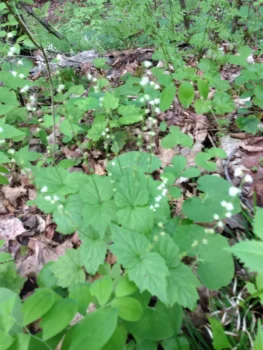
Twoleaf Miterwort: A Delicate Native Gem for Shaded Gardens
If you’re searching for a charming native groundcover that thrives in shade and offers delicate spring beauty, twoleaf miterwort (Mitella diphylla) might just be the perfect addition to your garden. This understated perennial brings subtle elegance to woodland settings while supporting local ecosystems.
What Makes Twoleaf Miterwort Special
Twoleaf miterwort is a native North American perennial forb that produces some of the most intricate tiny flowers you’ll ever see. In late spring, slender stems rise above heart-shaped leaves, topped with delicate white flowers that look like miniature fringed caps or mitres – hence the common name. Each flower is only about 1/8 inch across, but their intricate, lacy appearance makes them absolutely captivating when viewed up close.
This herbaceous perennial grows as a low groundcover, typically reaching 8-16 inches tall and spreading slowly through underground rhizomes to form gentle colonies over time.
Where Twoleaf Miterwort Grows Naturally
As a true native, twoleaf miterwort naturally occurs across eastern North America, from southeastern Canada down to Georgia and west to Minnesota and Arkansas. You can find it growing wild in Alabama, Arkansas, Connecticut, Delaware, District of Columbia, Georgia, Illinois, Indiana, Iowa, Kentucky, Maryland, Massachusetts, Michigan, Minnesota, Mississippi, Missouri, New Hampshire, New Jersey, New York, North Carolina, Ohio, Ontario, Pennsylvania, Quebec, South Carolina, Tennessee, Vermont, Virginia, West Virginia, and Wisconsin.
- Species observed
- No observations
Important Conservation Note
Before adding twoleaf miterwort to your garden, it’s important to know that this plant is considered rare in some areas. In Alabama, it has an S1 rarity status (critically imperiled), and in Arkansas, it’s rated S2 (imperiled). If you live in these states or other areas where the plant might be uncommon, please only purchase from reputable native plant nurseries that use responsibly sourced, nursery-propagated material – never collect from wild populations.
Perfect Garden Settings
Twoleaf miterwort shines in several garden scenarios:
- Woodland gardens: Pairs beautifully with other native woodland plants like wild ginger, trilliums, and ferns
- Shade groundcover: Creates a lovely carpet under trees and large shrubs
- Rock gardens: Thrives in the dappled shade of partially shaded rock gardens
- Native plant gardens: Essential for gardeners focused on supporting local ecosystems
Growing Conditions and Care
The good news for shade gardeners is that twoleaf miterwort is relatively easy to grow once you understand its preferences. This plant thrives in USDA hardiness zones 3-8, making it suitable for most temperate regions.
Light Requirements: Partial to full shade – this plant actually prefers shadier conditions and may struggle in too much sun.
Soil Preferences: Moist to medium-moist, well-draining soil rich in organic matter. While classified as facultative upland (meaning it usually grows in non-wetland areas), it appreciates consistent moisture without being waterlogged.
Planting Tips:
- Plant in spring or fall when temperatures are moderate
- Space plants 12-18 inches apart if creating a groundcover
- Amend soil with compost or leaf mold before planting
- Apply a 2-3 inch layer of organic mulch to retain moisture
Maintenance and Long-term Care
One of twoleaf miterwort’s greatest assets is its low-maintenance nature. Once established, it requires minimal care:
- Water during extended dry periods, especially in the first year
- Refresh organic mulch annually
- Allow leaves to remain through winter for natural protection
- Division is rarely necessary, but can be done in early spring if desired
In favorable conditions, twoleaf miterwort may self-seed, gradually expanding its presence in your garden naturally.
Wildlife and Pollinator Benefits
Despite their small size, the flowers of twoleaf miterwort attract various small native pollinators, including small bees and flies. The spring bloom time makes it particularly valuable for early-season pollinators when fewer flowers are available. As a native plant, it also supports local food webs in ways that non-native alternatives simply cannot.
Is Twoleaf Miterwort Right for Your Garden?
Consider twoleaf miterwort if you:
- Have shaded areas that need groundcover
- Appreciate subtle, delicate beauty over bold, showy displays
- Want to support native ecosystems and pollinators
- Prefer low-maintenance plants once established
- Are creating a woodland or naturalistic garden
This charming native offers a perfect blend of ecological value and quiet beauty. While it may not provide the dramatic impact of larger flowering perennials, twoleaf miterwort brings a special kind of magic to shaded gardens – the kind you discover when you take time to look closely at nature’s intricate details.