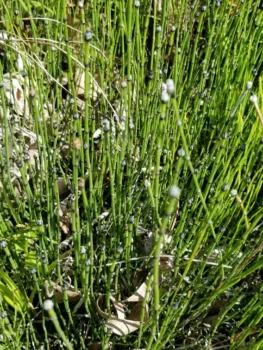
Variegated Scouringrush: A Living Fossil for Your Water Garden
Meet the variegated scouringrush (Equisetum variegatum var. variegatum), one of nature’s most ancient survivors that’s been gracing our planet for over 300 million years! This fascinating perennial isn’t your typical garden plant – it’s actually a primitive vascular plant that reproduces through spores rather than seeds, making it a true living fossil that can add prehistoric charm to modern landscapes.
What Makes This Plant Special
The variegated scouringrush belongs to the horsetail family, a group of plants that once towered as tall as trees during the age of dinosaurs. Today’s version is much more garden-friendly, featuring distinctive jointed stems with striking dark bands that give it its variegated appearance. Unlike typical flowering plants, this unique species is classified as a forb – a vascular plant without significant woody tissue that lacks the secondary growth you’d see in shrubs or trees.
Where It Calls Home
This remarkable plant has one of the most extensive native ranges you’ll find, spanning across Alaska, Canada (including Alberta, British Columbia, Manitoba, New Brunswick, Nova Scotia, Ontario, Quebec, Saskatchewan, Yukon, Northwest Territories, and Nunavut), Greenland, St. Pierre and Miquelon, and numerous states across the continental United States. From the rocky shores of Maine to the mountain meadows of Colorado and the wetlands of Wisconsin, variegated scouringrush has adapted to diverse northern climates.
- Species observed
- No observations
A Word of Caution: Rarity Status
Before you rush to add this prehistoric beauty to your garden, there’s something important to know: in New Jersey, variegated scouringrush is listed as Endangered with an S1 rarity status, meaning it’s critically imperiled in the state. It’s also listed in both the Pinelands and Highlands regions. If you’re considering growing this plant, please ensure you source it responsibly from reputable native plant nurseries rather than collecting from wild populations.
Garden Design Potential
For the right garden situation, variegated scouringrush can be a stunning addition. Its architectural, upright stems create vertical interest and provide a unique texture that contrasts beautifully with broader-leafed plants. This prehistoric charmer works especially well in:
- Bog gardens and rain gardens
- Naturalistic water features
- Contemporary landscapes seeking structural plants
- Native plant collections
- Educational gardens showcasing plant evolution
Growing Conditions
While specific growing requirements for this variety aren’t widely documented, horsetails generally thrive in consistently moist to wet conditions. Based on its extensive northern distribution, variegated scouringrush likely prefers cooler climates and can tolerate a range of light conditions from full sun to partial shade. Given its native range, it’s probably hardy in USDA zones 2-7, making it suitable for northern gardeners looking for unique water garden plants.
Wildlife and Ecological Benefits
As a spore-producing plant rather than a flowering species, variegated scouringrush doesn’t provide nectar for pollinators. However, its role in the ecosystem shouldn’t be underestimated. These ancient plants can provide habitat structure for small wildlife and contribute to the biodiversity of wetland environments.
The Bottom Line
Variegated scouringrush is a fascinating conversation starter that connects your garden to deep geological time. However, due to its endangered status in some regions and specialized growing requirements, it’s not for every gardener or every garden. If you’re drawn to this living fossil, make sure you can provide the consistently moist conditions it needs, source it responsibly, and consider it as part of a native plant collection or specialized water garden rather than a general landscape plant.
For most gardeners interested in native plants, there are many other wonderful options that are easier to grow and more widely available. But for those with the right conditions and a passion for botanical history, few plants can match the prehistoric appeal of the variegated scouringrush!