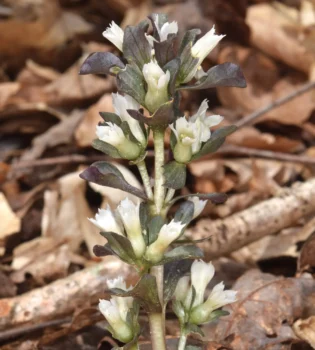
Virginia Pennywort: A Mysterious Woodland Treasure Worth Protecting
Meet Virginia pennywort (Obolaria virginica), one of North America’s most enigmatic native wildflowers. This unusual perennial isn’t your typical garden center find, and for good reason – it’s a rare and fascinating plant that lives life on its own terms, following rules that would make most gardeners scratch their heads in wonder.
What Makes Virginia Pennywort Special?
Virginia pennywort is a true oddball in the plant world. This small, herbaceous perennial belongs to the gentian family but has evolved some pretty unique survival strategies. Rather than relying solely on photosynthesis like most plants, it’s what botanists call a myco-heterotroph – essentially, it partners with fungi to borrow nutrients from nearby tree roots. Think of it as nature’s version of a very polite house guest.
The plant produces small, inconspicuous white to pale purple flowers that peek out from the forest floor, usually reaching only 3-6 inches tall. While it won’t win any beauty contests against showy garden perennials, its subtle charm and mysterious lifestyle make it a conversation starter for native plant enthusiasts.
Where Does Virginia Pennywort Call Home?
This native gem naturally occurs across 22 states in the eastern and southeastern United States, including Alabama, Arkansas, Delaware, District of Columbia, Florida, Georgia, Illinois, Indiana, Kentucky, Louisiana, Maryland, Mississippi, Missouri, New Jersey, North Carolina, Ohio, Pennsylvania, South Carolina, Tennessee, Texas, Virginia, and West Virginia.
- Species observed
- No observations
A Word of Caution: Rarity Matters
Before you get too excited about adding Virginia pennywort to your garden, there’s something important you need to know. This plant carries a rarity status of S2 in Arkansas and New Jersey, meaning it’s considered imperiled in these states. This designation serves as a reminder that Virginia pennywort populations are vulnerable and deserve our protection.
If you’re determined to grow this species, please only source plants or seeds from reputable native plant nurseries that can guarantee their stock comes from ethically propagated material – never from wild-collected plants.
Growing Virginia Pennywort: A Challenge for Advanced Gardeners
Let’s be honest – Virginia pennywort isn’t beginner-friendly. This plant has some very specific requirements that make it one of the more challenging native species to cultivate successfully.
Ideal Growing Conditions
Virginia pennywort thrives in USDA hardiness zones 5-9, but zone compatibility is just the beginning. Here’s what this finicky beauty really needs:
- Deep shade: We’re talking about the kind of shade found in mature forests, not just under a few trees
- Rich, humus-laden soil: Think forest floor conditions with years of decomposed leaf litter
- Consistent moisture: Not waterlogged, but never truly dry
- Established woodland ecosystem: Those fungal partnerships don’t happen in sterile garden soil
- Minimal disturbance: This plant likes things quiet and stable
The Reality Check: Why Virginia Pennywort Might Not Be for You
Before you fall head over heels for this rare beauty, consider these challenges:
- Extremely difficult to establish from seed or transplants
- Requires mature woodland conditions that can take decades to develop
- May disappear for years before resurging unexpectedly
- Offers minimal visual impact compared to showier natives
- Limited availability from ethical sources
Better Alternatives for Most Gardeners
If you’re drawn to Virginia pennywort’s woodland charm but want something more manageable, consider these easier native alternatives:
- Wild ginger (Asarum canadense) for low groundcover
- Hepatica (Hepatica nobilis) for early spring flowers
- Trout lily (Erythronium americanum) for unique foliage patterns
- Bloodroot (Sanguinaria canadensis) for striking spring blooms
Supporting Virginia Pennywort in the Wild
Sometimes the best way to appreciate a rare native plant is to protect it where it naturally occurs. Consider supporting local conservation organizations, participating in native plant society activities, or volunteering for habitat restoration projects in your area. These efforts help ensure that future generations can discover Virginia pennywort’s quiet magic in its natural woodland home.
The Bottom Line
Virginia pennywort represents the fascinating diversity of our native flora, but it’s not a plant for every garden or every gardener. Its rarity status and extremely specialized growing requirements make it better suited for advanced native plant enthusiasts with established woodland gardens and access to ethically sourced material.
For most of us, appreciating Virginia pennywort means learning about its unique ecology, supporting conservation efforts, and perhaps catching a glimpse of it during woodland walks. Sometimes the most precious plants are the ones we admire from a respectful distance, knowing we’re helping preserve their wild spaces for generations to come.