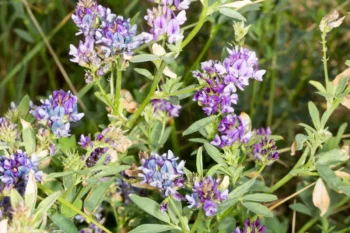
Alfalfa: The Purple-Flowered Powerhouse That’s More Than Just Livestock Feed
When most people hear alfalfa, they immediately think of hay bales and farm animals. But this humble purple-flowered plant, scientifically known as Medicago sativa sativa, has been quietly making its way into gardens and naturalized areas across North America for decades. Whether you’re considering adding it to your landscape or simply curious about those purple blooms you’ve spotted along roadsides, let’s dive into what makes alfalfa tick.
What Exactly Is Alfalfa?
Alfalfa is a forb—essentially a non-woody flowering plant—that belongs to the legume family. It’s what botanists call an annual perennial, meaning it can behave as either depending on growing conditions and climate. The plant produces distinctive trifoliate leaves (three leaflets per leaf) and small clusters of purple to violet flowers that are absolutely buzzing with pollinator activity during bloom time.
You might also encounter alfalfa under various scientific synonyms including Medicago media, Medicago sativa ssp. varia, or Medicago ×varia, but they’re all referring to the same plant we know and love.
Where Does Alfalfa Call Home?
Here’s where things get interesting: alfalfa isn’t actually native to North America. This Mediterranean and southwestern Asian native has become so well-established across the continent that it now grows wild from Alaska to Florida, and from coast to coast. You’ll find it thriving in virtually every U.S. state, Canadian province, and even in Hawaii, Puerto Rico, and the U.S. Virgin Islands.
- Species observed
- No observations
The Garden Debate: To Plant or Not to Plant?
As a non-native species that’s not classified as invasive or noxious, alfalfa falls into that interesting gray area where gardeners can make their own informed decisions. Here’s what you should consider:
The Case for Growing Alfalfa
- Pollinator magnet: Those purple blooms are absolute bee favorites, attracting honeybees, bumblebees, and butterflies
- Soil improvement: As a legume, alfalfa fixes nitrogen in the soil, actually improving soil fertility
- Deep roots: Its impressive taproot can extend several feet down, helping break up compacted soil
- Wildlife food: Seeds and foliage provide food for various bird species and small mammals
- Drought tolerance: Once established, it’s remarkably resilient during dry spells
The Case for Native Alternatives
If you’re passionate about supporting local ecosystems, consider these native legumes that offer similar benefits:
- Wild lupine (Lupinus species)
- Partridge pea (Chamaecrista fasciculata)
- Wild senna (Senna species)
- Native clovers (Trifolium species native to your region)
Growing Alfalfa Successfully
If you decide to give alfalfa a try, here’s how to set it up for success:
Growing Conditions
- Sunlight: Full sun is essential—alfalfa won’t tolerate shade
- Soil: Well-draining soils are crucial; alfalfa hates wet feet
- pH: Prefers slightly alkaline to neutral soils (pH 6.5-7.5)
- Hardiness: Thrives in USDA zones 3-9
Planting and Care Tips
- Seeding: Plant seeds in early spring or fall, about ¼ inch deep
- Spacing: Broadcast seeding works well for naturalized areas
- Inoculation: Consider inoculating seeds with rhizobia bacteria for better nitrogen fixation
- Establishment: Keep soil moist during germination, but avoid overwatering once established
- Maintenance: Minimal care needed once established; can self-seed readily
What to Expect
Alfalfa typically reaches 1-3 feet in height with a similar spread, though its deep taproot extends much further underground. The plant produces multiple flushes of purple flowers throughout the growing season, followed by small, coiled seed pods that add their own textural interest to the garden.
Keep in mind that alfalfa reproduces readily and can spread beyond where you originally planted it. While it’s not considered invasive, it’s definitely enthusiastic about making itself at home in suitable conditions.
The Bottom Line
Alfalfa is one of those plants that proves agriculture and ecology don’t have to be mutually exclusive. While it may not be native, it’s been a naturalized part of North American landscapes for so long that many ecosystems have adapted to include it. Whether you choose to grow it or opt for native alternatives, the most important thing is creating spaces that support pollinators and wildlife while bringing you joy in your garden.
Just remember: if you do plant alfalfa, embrace its independent spirit—because once this purple-flowered powerhouse decides it likes your garden, it’s likely to stick around for the long haul.