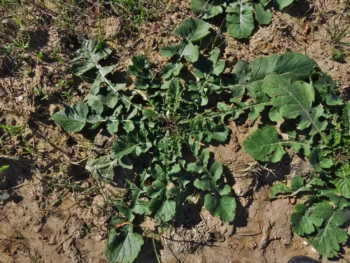
Annual Bastardcabbage: The Uninvited Garden Guest You Should Know About
If you’ve ever wondered about those small yellow flowers popping up uninvited in disturbed soil around your property, you might be looking at annual bastardcabbage (Rapistrum rugosum). While the name might sound a bit harsh, it’s actually quite descriptive of this opportunistic little plant that has made itself at home across much of North America, despite not being native to our continent.
What Exactly Is Annual Bastardcabbage?
Annual bastardcabbage is a non-woody annual plant (what botanists call a forb) that belongs to the mustard family. Originally from the Mediterranean region and parts of Europe, this hardy little survivor has managed to establish itself across a surprisingly wide range of North American locations. It’s one of those plants that doesn’t ask permission – it just shows up and makes itself comfortable.
The plant goes by the scientific name Rapistrum rugosum, and you might occasionally see it listed under some historical synonyms like Myagrum rugosum in older gardening references.
Where You’ll Find It
This adaptable annual has spread across a impressive range of locations, from the sunny shores of Hawaii to the cooler climates of Canada. You can find annual bastardcabbage established in California, Ontario, Quebec, Hawaii, Illinois, Indiana, Louisiana, Massachusetts, Missouri, Nevada, New Jersey, New Mexico, New York, Oregon, Pennsylvania, South Carolina, Tennessee, Texas, and Wisconsin. That’s quite the travel resume for a plant that started out in the Mediterranean!
- Species observed
- No observations
Interestingly, its status varies by region. In Canada, it’s considered a waif – meaning it shows up temporarily but doesn’t usually stick around permanently. In Hawaii and the continental United States, however, it’s become more persistently naturalized, reproducing on its own and maintaining populations without human help.
Should You Plant Annual Bastardcabbage?
Here’s the short answer: probably not. While we don’t have definitive information about whether annual bastardcabbage is officially classified as invasive or noxious, there are several good reasons why most gardeners choose to skip this one:
- It’s not native to North America, so it doesn’t support our local ecosystems as well as native plants would
- It tends to be weedy and can self-seed readily
- Its aesthetic appeal is fairly limited – think small yellow flowers that are more functional than beautiful
- There are many gorgeous native alternatives that would serve your garden better
What It Looks Like and Where It Grows
As an annual forb, annual bastardcabbage completes its entire life cycle in one growing season. It produces small yellow flowers arranged in clusters, and like many members of the mustard family, it’s quite tolerant of poor growing conditions. You’re most likely to spot it in disturbed soils, along roadsides, in vacant lots, or other areas where the ground has been turned over.
The plant seems to thrive in full sun conditions and isn’t particularly fussy about soil quality – which partly explains how it’s managed to establish itself so widely across different climate zones.
Better Native Alternatives
Instead of annual bastardcabbage, consider these native alternatives that will provide much more value to your local ecosystem:
- Wild bergamot – Attracts butterflies and bees with fragrant flowers
- Black-eyed Susan – Bright yellow blooms that birds and pollinators love
- Purple coneflower – Long-blooming perennial that feeds birds and butterflies
- Native asters – Late-season blooms when pollinators need them most
The Bottom Line
While annual bastardcabbage isn’t necessarily a garden villain, it’s not exactly a garden hero either. If you spot it growing on your property, you can certainly leave it be – it’s not going to cause major problems. But if you’re planning new plantings, your garden (and local wildlife) will be much better served by choosing native species that have evolved alongside our local pollinators and birds.
Think of annual bastardcabbage as that acquaintance who shows up uninvited to parties – not necessarily harmful, but probably not your first choice for a dinner invitation. When it comes to creating beautiful, ecologically valuable garden spaces, we can definitely do better!