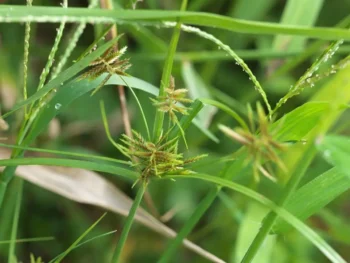
Asian Flatsedge: An Uninvited Guest in American Gardens
If you’ve spotted small, grass-like tufts with tiny brown flower heads popping up in moist corners of your garden, you might have encountered Asian flatsedge (Cyperus amuricus). This little sedge has quietly made itself at home across several eastern states, though it probably wasn’t on anyone’s planting wishlist when it first arrived from Asia.
What Exactly Is Asian Flatsedge?
Asian flatsedge is an annual sedge that belongs to the same plant family as the more familiar papyrus. Don’t let the grass in grass-like fool you – sedges are actually quite different from true grasses. You can remember the difference with the old gardener’s rhyme: sedges have edges (their stems are typically triangular), while grasses have round, hollow stems.
This particular sedge goes by the scientific name Cyperus amuricus, though you might occasionally see it listed under its synonym Cyperus microiria in older references. As an annual plant, it completes its entire life cycle in one growing season, sprouting from seed each spring and dying back with the first frost.
Where You’ll Find It Growing Wild
Asian flatsedge has established itself across a handful of eastern states, including Connecticut, Delaware, District of Columbia, Kentucky, Massachusetts, New Jersey, New York, Ohio, and Pennsylvania. It’s one of those plants that arrived from East Asia and decided to stick around, reproducing on its own without any help from gardeners.
- Species observed
- No observations
Why Most Gardeners Skip This One
Let’s be honest – Asian flatsedge isn’t going to win any beauty contests. This small, unassuming plant produces tiny brown flower clusters that are about as exciting as watching paint dry. Its narrow, grass-like leaves form small tufts that rarely catch the eye, and it tends to pop up in disturbed or weedy areas where you probably don’t want anything growing anyway.
Since it’s not native to North America, it doesn’t provide the same ecological benefits that our native plants offer to local wildlife. While it’s not classified as invasive in most areas, it’s also not contributing much to the local ecosystem – it’s basically just taking up space that could be occupied by more beneficial plants.
Growing Conditions (If You’re Curious)
Asian flatsedge isn’t particularly picky about where it grows, which is part of why it’s managed to establish itself across multiple states. It thrives in:
- Moist to wet soils
- Disturbed areas like roadsides and waste places
- Various soil types, from sandy to clayey
- USDA hardiness zones 6-9
The plant tends to appear in spring, grow through the summer, and set seed before dying back in fall. It’s wind-pollinated, so those small brown flowers don’t need to be showy to get the job done.
Better Alternatives for Your Garden
If you’re looking for native sedges that actually earn their keep in the garden, consider these fantastic alternatives:
- Pennsylvania sedge (Carex pensylvanica) – A wonderful native groundcover that works great as a lawn alternative
- Fox sedge (Carex vulpinoidea) – Excellent for rain gardens and wet areas
- Plantain-leaved sedge (Carex plantaginea) – Perfect for shade gardens with its broad, distinctive leaves
These native options will provide food and habitat for local wildlife while giving you much more ornamental bang for your buck.
The Bottom Line
Asian flatsedge is one of those plants that’s neither terrible nor terrific – it’s just there. While it’s not causing major ecological havoc, it’s also not adding much value to our gardens or natural areas. If you spot it growing on your property, you can leave it alone or remove it as you see fit. But if you’re planning a garden and want sedges that truly shine, stick with the native species that have evolved alongside our local ecosystems. Your local birds, butterflies, and other wildlife will thank you for it!