Non-native Plants

Asthmaweed

Conyza bonariensis

USDA symbol: COBO

annual forb

Lower 48 states: non-native, naturalized
Pacific Basin excluding Hawaii: non-native, naturalized

If you’ve noticed a tall, scraggly plant with tiny white flowers popping up uninvited in your garden, you’ve likely met asthmaweed (Conyza bonariensis). This annual to biennial forb has a knack for showing up where you least expect it, and while it’s not exactly a garden showstopper, it’s worth understanding ...

Asthmaweed: The Uninvited Garden Guest You Should Know About

If you’ve noticed a tall, scraggly plant with tiny white flowers popping up uninvited in your garden, you’ve likely met asthmaweed (Conyza bonariensis). This annual to biennial forb has a knack for showing up where you least expect it, and while it’s not exactly a garden showstopper, it’s worth understanding what you’re dealing with.

What Is Asthmaweed?

Asthmaweed goes by several names, including flax-leaf fleabane, horseweed, lani wela, and wavy-leaf fleabane. As a non-native species originally from South America, it has made itself quite at home across much of the United States, particularly in warmer regions. You’ll find this opportunistic plant in Alabama, Arizona, Arkansas, California, Florida, Georgia, Louisiana, Mississippi, Nevada, New Mexico, North Carolina, Oregon, South Carolina, Texas, Utah, Virginia, Washington, and several U.S. territories.

  • Species observed
  • No observations

This hardy forb typically grows as an annual or biennial, meaning it completes its life cycle in one to two years. It’s what botanists call a pioneer species – one of the first plants to colonize disturbed soil.

Identifying Asthmaweed

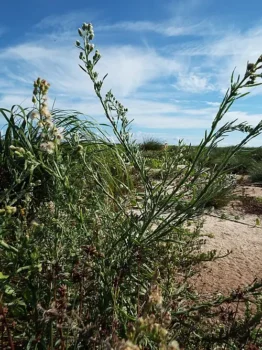
Asthmaweed can reach heights of 3-6 feet, making it hard to miss once established. Here are its key identifying features:

  • Narrow, linear leaves that may have wavy edges
  • Small, inconspicuous white to pale yellow flowers arranged in dense, branching clusters
  • Tall, often scraggly growth habit
  • Preference for disturbed soils and full sun locations

Should You Plant Asthmaweed?

Here’s the thing about asthmaweed – most gardeners don’t plant it intentionally, and there are good reasons for that. While it’s not officially classified as invasive or noxious, it’s not exactly what you’d call garden-worthy either. Its appearance is rather weedy, and it has a tendency to self-seed prolifically, potentially creating more plants than you bargained for.

The plant does offer some minor benefits to pollinators, as its small flowers attract various insects. However, if you’re looking to support pollinators, you’d be much better served by choosing native alternatives that provide superior nectar sources and habitat value.

Growing Conditions and Care

If asthmaweed does appear in your garden (and it probably will on its own), it thrives in:

  • Full sun locations
  • Poor, disturbed soils
  • Drought conditions
  • USDA hardiness zones 8-11

The plant has different wetland preferences depending on your region, but generally prefers non-wetland areas, though it can tolerate some moisture variation.

Better Native Alternatives

Instead of letting asthmaweed take over, consider these native alternatives that offer superior benefits:

  • Native asters (Symphyotrichum species) for late-season pollinator support
  • Native fleabanes (Erigeron species) for similar appearance but better ecological value
  • Native goldenrods (Solidago species) for robust pollinator habitat

These natives will provide much better support for local wildlife while giving you more control over your garden’s appearance.

Managing Asthmaweed

If you decide you don’t want asthmaweed in your garden, early intervention is key. Remove plants before they set seed, and focus on improving soil conditions and establishing desirable plants to outcompete future seedlings. Remember, nature abhors a vacuum – the best defense against weedy species is a thriving garden full of plants you actually want.

While asthmaweed isn’t a garden villain, it’s certainly not a garden hero either. Understanding what you’re dealing with helps you make informed decisions about your landscape and choose plants that truly deserve a place in your garden.

Conyza bonariensis is also known as...

Often we refer to plants by their common names. When shopping for plants the scientific name is the best way to positively identify the plant species you desire. But some plants have more than one name! While it doesn't happen often, nurseries might display one name while you're searching for another. Conyza bonariensis is also known as:

Erigeron bonariensis | USDA symbol: ERBO4
Erigeron crispus | USDA symbol: ERCR11
Erigeron linifolius | USDA symbol: ERLI2
Leptilon bonariense | USDA symbol: LEBO3
Leptilon linifolium | USDA symbol: LELI3

Why do some plants have more than one name? Over time plant species may be renamed for a few reasons:

  1. Botanists in different regions named the same plant without knowing it had already been classified.
  2. A species was reclassified after scientific advances in, for example, DNA analysis.
  3. Slight variations within a species are sometimes mistakenly identified as entirely new species.

Wetland Status

The rule of seasoned gardeners and landscapers is to choose the "right plant for the right place" — matching plants to their ideal growing conditions, so they'll thrive with less care and fewer inputs. But the simplicity of this catchphrase conceals how tricky plant selection can be if you don't have the right information. While tags on nursery plants list watering requirements, there's more to the story.

Knowing a plant's wetland status can simplify the process by revealing the interaction between plants, water, and soil. You might be surprised to learn that popular landscape plants are wetland species! And what may be a wetland plant in one area, in another it might thrive in drier conditions. The table below gives insight into the preferred growing conditions of this plant throughout its geographical distribution.

Region
Preferred Habitat

Arid West (AZ, CA, CO, ID, MT, NV, NM, OR, TX, UT, WA, WY)

Facultative Upland

Atlantic and Gulf Coastal Plain (AL, AR, DC, DE, FL, GA, IL, KY, LA, MD, MS, MO, NC, NJ, OK, PA, SC, TN, TX, VA)

Facultative Upland

Caribbean (PR, VI)

Obligate Upland

Eastern Mountains and Piedmont (AL, AR, DC, DE, GA, IL, IN, KS, KY, MD, MO, NC, NJ, NY, OH, OK, PA, SC, TN, VA, WV)

Facultative Upland

Great Plains (CO, KS, MN, MT, NE, NM, ND, OK, SD, TX, WY)

Facultative Upland

Hawaii ()

Facultative

Western Mountains, Valleys, and Coast (AZ, CA, CO, ID, MT, NV, NM, OR, SD, UT, WA, WY)

Facultative Upland
Wetland Glossary
Obligate Wetland
Facultative Wetland
Facultative
Facultative Upland
Obligate Upland
Almost always occurs in wetlands
Usually occurs in wetlands but may occur in non-wetlands
Can occur in wetlands and non-wetlands
Usually occurs in non-wetlands but may occur in wetlands
Almost never occurs in wetlands

Classification

Group: Dicot
Kingdom: Plantae - Plants
Subkingdom: Tracheobionta - Vascular plants
Superdivision: Spermatophyta - Seed plants
Division: Magnoliophyta - Flowering plants
Class: Magnoliopsida - Dicotyledons
Subclass: Asteridae
Order: Asterales
Family: Asteraceae Bercht. & J. Presl - Aster family
Genus: Conyza Less. - horseweed

Species: Conyza bonariensis (L.) Cronquist - asthmaweed

Plant data source: USDA, NRCS 2025. The PLANTS Database. https://plants.usda.gov,. 2/25/2025. National Plant Data Team, Greensboro, NC USA