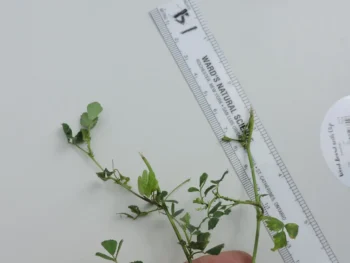
Blackdisk Medick: A Curious Annual with Spiral Seed Pods
Meet blackdisk medick (Medicago orbicularis), a quirky little annual that might just surprise you with its distinctive characteristics. Also known as button-clover or large-disc medic, this Mediterranean native has quietly established itself across many U.S. states, bringing its unique spiral seed pods and cheerful yellow flowers along for the ride.
What Makes Blackdisk Medick Special?
The most fascinating feature of blackdisk medick has to be its seed pods. These flat, disk-shaped pods coil into perfect spirals that look almost too geometric to be natural. Combined with small, bright yellow flowers that bloom in spring, this low-growing forb creates an interesting texture in the landscape that’s quite different from your typical garden plants.
As an annual herb, blackdisk medick completes its entire life cycle in one growing season, typically reaching just a few inches in height but spreading outward in a prostrate, ground-hugging pattern.
Native Status and Distribution
While blackdisk medick isn’t native to North America (it originally hails from the Mediterranean region), it has naturalized across thirteen states, including Alabama, California, Florida, Georgia, Illinois, Louisiana, Maryland, Mississippi, New Jersey, North Carolina, Oklahoma, Tennessee, and Texas. As a non-native species that reproduces on its own, it’s established itself as part of the naturalized flora in these areas.
- Species observed
- No observations
Garden Role and Landscape Use
If you’re considering blackdisk medick for your garden, here’s what it brings to the table:
- Low-maintenance ground cover for naturalized areas
- Nitrogen-fixing abilities that can improve soil health
- Interesting textural element with its unique seed pods
- Self-seeding annual that returns year after year
This plant works best in wildflower meadows, naturalized landscapes, or areas where you want a low-maintenance, self-sustaining ground cover. It’s not the showiest plant, but it adds subtle interest and ecological function.
Growing Conditions and Care
One of blackdisk medick’s strongest suits is its easygoing nature. This adaptable annual thrives in:
- Full sun locations
- Poor to average soils (sandy or clay)
- Areas with minimal water once established
- USDA zones 8-10, though as an annual it’s quite flexible with temperature
For planting, scatter seeds in fall or early spring directly where you want them to grow. Once established, this plant requires virtually no care and will self-seed for future seasons.
Wildlife and Pollinator Benefits
While blackdisk medick may not be the most spectacular wildlife magnet, it does provide modest benefits:
- Small yellow flowers attract bees and other small pollinators during blooming season
- Seeds and foliage provide supplemental food (about 5-10% of diet) for various animals including large mammals, small mammals, and terrestrial birds
- Low-growing habit offers minimal cover for small wildlife
Should You Plant Blackdisk Medick?
The decision comes down to your gardening goals. If you’re looking for a low-maintenance, self-seeding annual for naturalized areas and don’t mind non-native species, blackdisk medick could work well. Its nitrogen-fixing abilities and unique aesthetic make it an interesting addition to meadow gardens.
However, if you’re committed to native gardening, consider these native alternatives that offer similar benefits:
- Native clovers and vetches in your region
- Local wildflower species that provide ground cover
- Native legumes that also fix nitrogen
Whatever you choose, blackdisk medick represents one of nature’s more geometrically inclined creations—those spiral seed pods alone make it worth knowing about, even if you never plant it yourself!