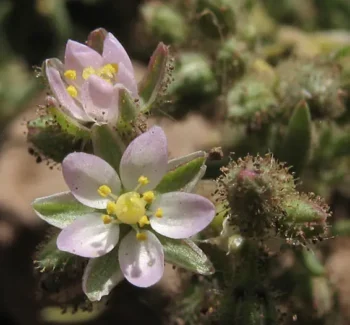
Boccone’s Sandspurry: A Delicate Ground Cover for Sandy Gardens
Meet Boccone’s sandspurry (Spergularia bocconii), a charming little annual that might just be the unsung hero your sandy garden needs. This diminutive ground cover brings subtle beauty to challenging spots where other plants fear to tread, though it comes with a few considerations worth knowing about.
What Is Boccone’s Sandspurry?
Boccone’s sandspurry is a small annual forb – that’s gardener-speak for a non-woody plant that completes its life cycle in one growing season. You might also see it listed under its synonyms Spergularia bocconi or Tissa luteola in older gardening references. This petite plant forms low-growing mats and produces tiny, delicate flowers that add a whisper of color to the landscape.
Where Does It Grow?
Originally hailing from the Mediterranean region, Boccone’s sandspurry has made itself at home along the West Coast of the United States. You’ll find it growing wild in California, Oregon, and Washington, where it has established itself as a naturalized resident.
- Species observed
- No observations
Is It Native?
Here’s where things get interesting: Boccone’s sandspurry is not native to North America. It’s what botanists call a non-native introduced species that reproduces on its own in the wild. While it’s not currently listed as invasive, this means it’s worth considering native alternatives that provide similar benefits while supporting local ecosystems.
What Does It Look Like?
Don’t expect a showstopper – Boccone’s sandspurry is all about subtle charm. This low-growing annual forms spreading mats with small, narrow leaves and produces tiny pink to white flowers. It’s the kind of plant that creates a delicate carpet effect rather than bold focal points. The overall effect is soft and understated, perfect for gardeners who appreciate quiet beauty.
Where Can You Grow It?
Based on its current distribution, Boccone’s sandspurry thrives in USDA hardiness zones 8-10. It’s particularly well-suited for:
- Coastal gardens where salt tolerance is important
- Rock gardens with sandy, well-draining soil
- Naturalized areas that need gentle ground cover
- Spots with poor soil where other plants struggle
Growing Conditions
This little Mediterranean native has simple tastes. It prefers full sun and sandy, well-draining soils – the kind of conditions that make many gardeners throw up their hands in frustration. Boccone’s sandspurry actually thrives in poor soils and handles both drought and salt exposure like a champ.
Interestingly, this plant has a flexible relationship with water. In arid western regions, it’s considered a facultative wetland plant, meaning it usually grows in wet areas but can handle drier conditions. In mountainous and coastal areas, it’s simply facultative, happily growing in both wet and dry spots.
Planting and Care Tips
The good news? Boccone’s sandspurry is refreshingly low-maintenance. As a self-seeding annual, it often takes care of its own propagation. Here are the basics:
- Plant in full sun for best results
- Ensure excellent drainage – soggy soil is its enemy
- Don’t worry about fertilizing; it prefers poor soils
- Water sparingly once established
- Allow it to self-seed for natural spreading
Wildlife and Pollinator Benefits
While small, the flowers of Boccone’s sandspurry do provide nectar for tiny pollinators, including small native bees and flies. However, since this isn’t a native species, it won’t support native wildlife as comprehensively as indigenous plants would.
Should You Plant It?
Boccone’s sandspurry occupies an interesting middle ground. It’s not invasive, but it’s not native either. If you’re dealing with challenging sandy soils and need a tough little ground cover, it could work well. However, consider exploring native alternatives first, such as:
- Native sedums for similar mat-forming habits
- Regional native wildflowers adapted to sandy soils
- Indigenous coastal plants if you’re in a seaside location
If you do choose to grow Boccone’s sandspurry, it’s unlikely to cause problems and will certainly handle tough growing conditions with aplomb. Just remember that every garden is an opportunity to support native ecosystems, so consider mixing it with native plants that provide maximum benefits to local wildlife.
Whether you’re drawn to its understated charm or simply need something that can handle your garden’s challenging spots, Boccone’s sandspurry proves that sometimes the most unassuming plants can be surprisingly useful allies in the garden.