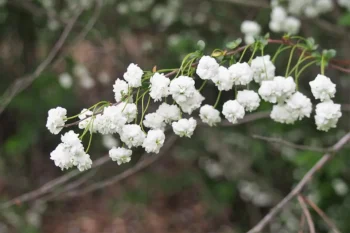
Bridalwreath Spirea: A Classic Spring Bloomer for Your Garden
If you’ve ever strolled through an older neighborhood in spring and noticed gracefully arching shrubs covered in clouds of white flowers, you’ve likely encountered bridalwreath spirea (Spiraea prunifolia). This classic ornamental shrub has been gracing American gardens for well over a century, bringing reliable spring beauty with its distinctive double white blooms.
What is Bridalwreath Spirea?
Bridalwreath spirea is a deciduous, multi-stemmed shrub that typically reaches 4-6 feet in both height and width. As a perennial woody plant, it returns year after year, developing an elegant vase-like shape with gracefully arching branches. The shrub gets its romantic common name from its profusion of small, white, rose-like flowers that appear in dense clusters along the stems in early spring, resembling a bridal veil.
Native Status and Distribution
Originally native to China, Japan, and Korea, bridalwreath spirea is a non-native species that has naturalized across much of North America. It now grows wild and reproduces without human intervention across a wide range, including states from the Southeast to the Northeast and into parts of Canada.
You can find established populations in Alabama, Arkansas, Connecticut, Delaware, Georgia, Illinois, Kentucky, Louisiana, Maryland, Massachusetts, Mississippi, Missouri, New Jersey, New York, North Carolina, Ohio, Pennsylvania, Tennessee, Virginia, Washington D.C., and the Canadian provinces of Nova Scotia and Ontario.
- Species observed
- No observations
Garden Appeal and Landscape Role
What makes bridalwreath spirea a garden favorite? Several standout features:
- Spring spectacle: Dense clusters of pure white, double flowers create a stunning display in early spring
- Graceful form: Arching branches create an elegant, fountain-like silhouette
- Fall interest: Leaves turn attractive shades of yellow and orange before dropping
- Low maintenance: Once established, it’s quite drought tolerant and requires minimal care
In landscape design, bridalwreath spirea works beautifully as a specimen plant, foundation planting, or as part of a mixed shrub border. Its classic cottage garden appeal makes it perfect for traditional and informal garden styles.
Growing Conditions and Care
Bridalwreath spirea is remarkably adaptable and forgiving, thriving in USDA hardiness zones 4-8. Here’s what it needs to flourish:
- Light: Full sun to partial shade (blooms best with at least 6 hours of direct sunlight)
- Soil: Well-draining soil of average fertility; tolerates various soil types
- Water: Regular watering the first year, then quite drought tolerant
- Space: Allow 4-6 feet between plants for proper air circulation
Planting and Maintenance Tips
Plant bridalwreath spirea in spring or fall when temperatures are moderate. Dig a hole twice as wide as the root ball but no deeper, and water thoroughly after planting. During the first growing season, maintain consistent moisture to help establish a strong root system.
The key to keeping bridalwreath spirea looking its best is proper pruning. Since it blooms on old wood, prune immediately after flowering ends. Remove about one-third of the oldest canes each year to encourage new growth and maintain the shrub’s graceful shape.
Wildlife and Pollinator Considerations
While bridalwreath spirea produces abundant flowers, its double blooms offer limited value to pollinators since the extra petals reduce access to nectar and pollen. Birds may use the dense branching for nesting, but overall wildlife benefits are modest compared to native alternatives.
Should You Plant Bridalwreath Spirea?
Bridalwreath spirea can be a lovely addition to gardens where its classic spring display and low-maintenance nature are appreciated. However, since it’s not native to North America, consider incorporating native alternatives alongside it or instead of it to better support local ecosystems.
Excellent native alternatives include:
- Ninebark (Physocarpus opulifolius) – similar white flower clusters, excellent wildlife value
- Serviceberry (Amelanchier species) – spring blooms plus edible berries
- Spicebush (Lindera benzoin) – early spring flowers, important butterfly host plant
If you do choose to plant bridalwreath spirea, you’ll enjoy a reliable, beautiful shrub that asks for little but gives generously each spring. Just remember to pair it with native plants to create a more ecologically balanced landscape that supports local wildlife while still enjoying this classic garden beauty.