Bulbous Canarygrass: A Hardy Non-Native Grass for Tough Growing Conditions
Meet bulbous canarygrass (Phalaris aquatica), a resilient perennial grass that’s made itself at home across various regions of the United States. While it didn’t originate here, this Mediterranean native has proven itself as a tough, adaptable grass that can handle some pretty challenging growing conditions where many other plants would throw in the towel.
What Exactly is Bulbous Canarygrass?
Bulbous canarygrass is a perennial graminoid—basically a fancy way of saying it’s a grass or grass-like plant. Originally from the Mediterranean region of Europe, North Africa, and western Asia, this species has established itself as a non-native resident that reproduces on its own in the wild across multiple U.S. states.
You might also encounter this grass under its former scientific names, including Phalaris tuberosa, which explains why some folks still call it by that moniker. The bulbous part of its common name refers to the somewhat swollen base of the plant.
Where You’ll Find It Growing
Bulbous canarygrass has settled into life across a diverse range of states, from the sunny shores of California and Hawaii to the varied landscapes of Arizona, Texas, Virginia, and several others including District of Columbia, Mississippi, Montana, North Carolina, Oregon, and South Carolina.
- Species observed
- No observations
What Does It Look Like?
This grass definitely makes a statement in the landscape, though perhaps not always a subtle one. Here’s what to expect:
- Mature height reaches about 4 feet tall
- Erect, upright growth form with a rhizomatous spreading habit
- Green foliage with a coarse texture
- Yellow flowers that appear in early spring (though they’re not particularly showy)
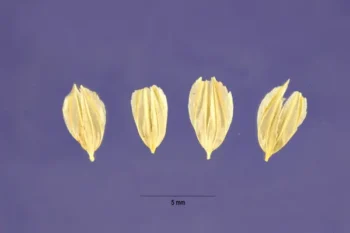
- Black seeds that follow the flowering period
- Dense winter foliage that opens up to moderate porosity in summer
The growth rate is impressively rapid, and this grass actively grows during fall, winter, and spring—making it quite different from many of our native warm-season grasses.
Growing Conditions and Hardiness
Here’s where bulbous canarygrass really shines—it’s remarkably tolerant of challenging conditions that would stress out more finicky plants. This makes it suitable for USDA hardiness zones 8-11, handling temperatures down to about 7°F.
Ideal Growing Conditions:
- Soil: Adapts well to fine and medium-textured soils, though it’s not fond of coarse, sandy soils
- pH: Prefers slightly acidic to neutral conditions (5.4 to 7.5)
- Moisture: High moisture use but excellent drought tolerance once established
- Sunlight: Full sun only—this grass is shade intolerant
- Climate: Thrives in areas with 16-40 inches of annual precipitation
Tolerance Superpowers:
- High drought tolerance
- High fire tolerance
- High tolerance for waterlogged conditions
- Medium salt tolerance
- Handles a frost-free period as short as 240 days
Wetland Status Across Regions
Bulbous canarygrass shows interesting regional variations in its relationship with wet areas:
- In most regions (Arid West, Atlantic and Gulf Coastal Plain, Eastern Mountains and Piedmont, Western Mountains), it’s classified as Facultative Upland—meaning it usually prefers drier sites but can handle some wetness
- In the Great Plains and Hawaii, it’s simply Facultative—equally comfortable in wet or dry conditions
How to Grow Bulbous Canarygrass
The good news? This grass is pretty straightforward to establish and maintain.
Planting:
- Propagation is primarily by seed (about 340,800 seeds per pound!)
- Seeds are routinely available commercially
- Best planted in early spring when soil temperatures warm up
- Seedling vigor is low, so be patient with establishment
- No cold stratification required for seed germination
Care and Maintenance:
- Requires medium fertility—not a heavy feeder but benefits from some nutrition
- Deep watering encourages the roots to extend down at least 12 inches
- Rapid regrowth after cutting or grazing
- Long lifespan once established
- Moderate vegetative spread rate through rhizomes
Should You Plant Bulbous Canarygrass?
This is where things get a bit nuanced. Bulbous canarygrass isn’t invasive or noxious, but it’s also not native to North America. Here are some scenarios where it might make sense:
Consider it for:
- Erosion control on slopes or disturbed areas
- Drought-prone areas where native options struggle
- Agricultural or utilitarian landscapes
- Areas with challenging soil conditions
- Fire-prone landscapes due to its fire tolerance
Think twice if:
- You’re creating habitat for native wildlife
- Your goal is supporting local pollinators (this is wind-pollinated)
- You’re in a shaded location
- You prefer lower-maintenance, slower-spreading options
Native Alternatives to Consider
Before committing to bulbous canarygrass, consider these native alternatives that might offer similar benefits while supporting local ecosystems:
- Buffalo grass (Bouteloua dactyloides) for drought tolerance
- Little bluestem (Schizachyrium scoparium) for erosion control
- Blue grama (Bouteloua gracilis) for tough conditions
- Regional native bunch grasses specific to your area
The Bottom Line
Bulbous canarygrass is like that reliable friend who’s always ready for an adventure—tough, adaptable, and not particularly high-maintenance. While it’s not going to win any awards for supporting native wildlife or pollinators, it certainly has its place in landscapes where durability and erosion control are the primary goals.
If you’re dealing with challenging growing conditions and need something that can establish quickly and hang tough through droughts, fires, and poor soils, bulbous canarygrass might be worth considering. Just remember that choosing native alternatives when possible helps support the broader ecosystem that our local wildlife depends on.