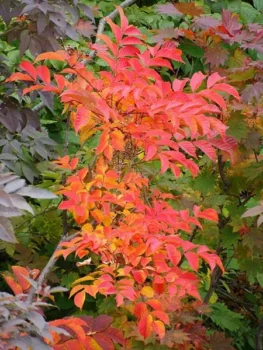
Chinese Lacquer Tree: A Beautiful But Dangerous Addition to Consider
If you’ve ever encountered poison ivy and lived to tell the tale, you might want to think twice before adding the Chinese lacquer tree (Toxicodendron vernicifluum) to your garden wishlist. This stunning deciduous tree, also known by its former scientific names Rhus vernicifera and Rhus verniciflua, packs the same punch as its notorious cousin – but in a much larger package.
What Makes This Tree Special (and Scary)
The Chinese lacquer tree is undeniably gorgeous, especially in fall when its large compound leaves burst into brilliant shades of orange and red. Native to East Asia, including China, Korea, and Japan, this tree has been cultivated for centuries – not just for its beauty, but for the toxic sap that’s traditionally used to make lacquerware.
But here’s the catch: this tree contains the same urushiol compounds found in poison ivy, poison oak, and poison sumac. Every part of the plant – leaves, bark, roots, and especially the milky sap – can cause severe allergic reactions in most people.
Garden Role and Landscape Considerations
In its native habitat, the Chinese lacquer tree serves as:
- A large specimen tree that can reach 40-60 feet tall and wide
- An excellent source of fall color in large landscapes
- A provider of small, greenish flowers that attract various pollinators in late spring
- Habitat and food for birds through its small berries
Growing Conditions and Care
If you’re still considering this tree (and we really hope you’re not for a typical home garden), it thrives in:
- USDA hardiness zones 4-8
- Full sun to partial shade locations
- Well-drained soils with moderate moisture
- Spacious areas where it can reach its full mature size
The tree is relatively low-maintenance once established, but handling any part of it requires extreme caution and protective equipment.
Why You Should Probably Skip This One
While the Chinese lacquer tree isn’t considered invasive in North America, there are compelling reasons to avoid planting it:
- Severe allergic reactions affecting most people who come into contact with it
- Difficulty in maintenance and pruning due to toxic properties
- Liability concerns if planted where others might accidentally contact it
- Limited suitable locations due to its large mature size
Better Native Alternatives
Instead of risking a trip to the emergency room, consider these native trees that offer similar benefits without the danger:
- Sugar maple (Acer saccharum) for spectacular fall color
- Black gum (Nyssa sylvatica) for brilliant orange-red autumn display
- Red oak (Quercus rubra) for large size and wildlife value
- American beech (Fagus grandifolia) for year-round interest
The Bottom Line
The Chinese lacquer tree might be a showstopper in terms of beauty, but it’s also a potential showstopper for anyone who gets too close. Unless you’re running a botanical garden with proper safety protocols, this is one tree that’s better admired from afar – preferably in its native habitat or specialized collections. Your skin (and your neighbors) will thank you for choosing one of the many safer alternatives that can provide similar aesthetic benefits without the risk.
Remember: when it comes to gardening, beautiful doesn’t always mean suitable for your backyard!