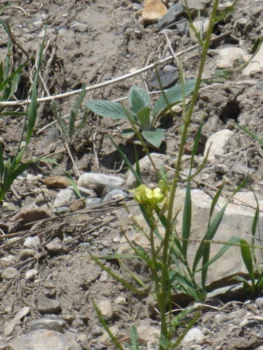
Common Dogmustard: What Every Gardener Should Know About This Widespread Non-Native
If you’ve ever wondered about those small yellow flowers popping up in disturbed soil around your garden, you might be looking at common dogmustard (Erucastrum gallicum). This unassuming member of the mustard family has quite the story to tell – and quite the range to show for it!
What Exactly Is Common Dogmustard?
Common dogmustard is an annual to biennial forb that belongs to the Brassicaceae (mustard) family. As a forb, it’s a non-woody plant that completes its life cycle in one to two years. You might also see it listed under its synonym Brassica erucastrum in older gardening references.
This European native has made itself quite at home across North America, establishing populations from coast to coast. It’s one of those plants that proves how adaptable nature can be when given the chance.
Where You’ll Find Common Dogmustard
Talk about a well-traveled plant! Common dogmustard has spread across an impressive range, establishing itself in virtually every U.S. state and Canadian province. From Alaska’s challenging climate to Florida’s heat, from California’s diverse landscapes to Maine’s rocky soils – this plant has proven remarkably adaptable.
- Species observed
- No observations
Should You Plant Common Dogmustard in Your Garden?
Here’s where things get interesting. While common dogmustard isn’t typically considered a garden-worthy ornamental, it’s not necessarily a villain either. Since its invasive status isn’t clearly established, we can’t definitively say don’t plant it, but we also can’t enthusiastically recommend it.
Consider these factors:
- It’s not native to North America, so it doesn’t provide the same ecological benefits as indigenous plants
- Its appearance is rather weedy and not particularly ornamental
- As a non-native species, it may compete with local flora
- Its widespread distribution suggests it can be quite aggressive in spreading
Native Alternatives to Consider Instead
If you’re drawn to the mustard family’s characteristics, consider these native alternatives that will better support your local ecosystem:
- Wild mustard species native to your region
- Native wildflowers in the Brassicaceae family
- Regional spring ephemerals that fill similar ecological niches
Growing Conditions and Characteristics
Should you encounter common dogmustard in your landscape (and you very well might, given its wide distribution), here’s what to expect:
This adaptable plant thrives in disturbed soils and can tolerate a wide range of conditions. Its success across such diverse climates – from arctic Alaska to subtropical Florida – demonstrates its remarkable flexibility. The small yellow flowers appear in clusters and may attract some pollinators, though they’re not particularly showy.
The Bottom Line for Gardeners
Common dogmustard represents an interesting case study in plant adaptation and spread. While it’s not necessarily harmful, it’s also not the best choice for intentional cultivation. Instead of planting this non-native species, consider supporting your local ecosystem by choosing indigenous alternatives that provide better wildlife habitat and maintain regional biodiversity.
Remember, every plant choice in our gardens is a vote for the kind of landscape we want to see. When possible, casting that vote for native species helps create stronger, more resilient ecosystems right in our own backyards.