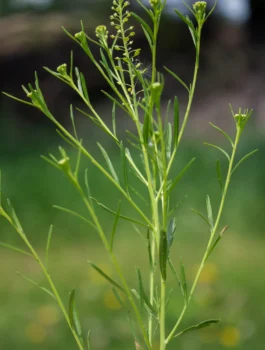
Non-native Plants

Common Pepperweed

Lepidium densiflorum

USDA symbol: LEDE

annual forb

Alaska: probably non-native, naturalized
Hawaii: non-native, naturalized
Lower 48 states: native in some areas, naturalized in others

If you’ve ever noticed tiny white flowers clustered on small, weedy-looking plants in disturbed areas of your garden or along walkways, you might have encountered common pepperweed (Lepidium densiflorum). This little annual or biennial forb has a knack for showing up uninvited, and while it’s not going to win any ...

Common Pepperweed: The Uninvited Garden Guest You Probably Already Have

If you’ve ever noticed tiny white flowers clustered on small, weedy-looking plants in disturbed areas of your garden or along walkways, you might have encountered common pepperweed (Lepidium densiflorum). This little annual or biennial forb has a knack for showing up uninvited, and while it’s not going to win any beauty contests, it’s worth understanding what it is and how it behaves in your landscape.

What Exactly is Common Pepperweed?

Common pepperweed is a small forb—basically a non-woody plant that lacks any significant woody tissue above ground. As an annual or biennial, it completes its life cycle in one to two years, producing small white flowers and then setting seed before dying back. The plant belongs to the mustard family and has numerous botanical synonyms, indicating it’s been studied and reclassified multiple times over the years.

Where You’ll Find It Growing

This adaptable little plant has made itself at home across most of the United States, growing in states from Alabama to Alaska, and from California to Maine. It’s also established in Hawaii. The plant’s native status is somewhat murky—it appears to be non-native in Alaska and Hawaii, while its status in the lower 48 states remains undefined.

  • Species observed
  • No observations

Should You Plant Common Pepperweed?

Here’s the honest truth: most gardeners don’t deliberately plant common pepperweed, and for good reason. While it’s not classified as invasive or noxious, it’s not particularly ornamental either. The small white flowers are fairly inconspicuous, and the plant tends to look more weedy than garden-worthy.

If you’re looking to support native ecosystems, consider these native alternatives instead:

  • Wild bergamot (Monarda species) for pollinator support
  • Native asters for late-season blooms
  • Regional wildflower mixes suited to your specific area

Growing Conditions and Care

If common pepperweed has already volunteered in your garden, you’ll quickly discover it’s remarkably adaptable. The plant thrives in disturbed soils and seems to prefer upland conditions, though its wetland status varies by region:

  • In arid western regions and Hawaii: Almost never found in wetlands
  • In the Great Plains, Eastern Mountains, and Midwest: Can occur in both wetlands and uplands
  • In most other regions: Usually stays in non-wetland areas but may occasionally appear in wetlands

The plant requires minimal care—in fact, it thrives on neglect. It’s perfectly happy in poor soils, disturbed areas, and locations where more finicky plants might struggle.

Wildlife and Pollinator Benefits

While common pepperweed may not be a showstopper, its small flowers can provide nectar for tiny beneficial insects. However, if supporting pollinators is your goal, you’ll get much more bang for your buck with native flowering plants that have co-evolved with local wildlife.

Managing Common Pepperweed in Your Garden

If you’d prefer to keep common pepperweed from spreading, the easiest approach is to pull it before it sets seed. As an annual or biennial, preventing seed production will gradually reduce its presence in your garden. The shallow root system makes it relatively easy to remove by hand.

Alternatively, if you have areas where you need quick ground cover in disturbed soil, you might choose to tolerate it temporarily while establishing more desirable plants.

The Bottom Line

Common pepperweed is one of those plants that exists in the gray area between weed and wildflower. While it’s not harmful to grow, it’s not particularly beneficial either. Most gardeners will be happier focusing their efforts on native plants that provide better wildlife support and more garden appeal. But if it shows up on its own? Well, now you know what it is and can make an informed decision about whether to let it stay or show it the door.

Lepidium densiflorum is also known as...

Often we refer to plants by their common names. When shopping for plants the scientific name is the best way to positively identify the plant species you desire. But some plants have more than one name! While it doesn't happen often, nurseries might display one name while you're searching for another. Lepidium densiflorum is also known as:

Lepidium densiflorum var. densiflorum | USDA symbol: LEDED
Lepidium densiflorum var. elongatum | USDA symbol: LEDEE
Lepidium densiflorum var. macrocarpum | USDA symbol: LEDEM
Lepidium densiflorum var. pubecarpum | USDA symbol: LEDEP
Lepidium densiflorum var. ramosum | USDA symbol: LEDER
Lepidium densiflorum var. typicum | USDA symbol: LEDET
Lepidium elongatum | USDA symbol: LEEL4
Lepidium neglectum | USDA symbol: LENE7
Lepidium pubecarpum | USDA symbol: LEPU6
Lepidium ramosum | USDA symbol: LERA6

Why do some plants have more than one name? Over time plant species may be renamed for a few reasons:

  1. Botanists in different regions named the same plant without knowing it had already been classified.
  2. A species was reclassified after scientific advances in, for example, DNA analysis.
  3. Slight variations within a species are sometimes mistakenly identified as entirely new species.

Wetland Status

The rule of seasoned gardeners and landscapers is to choose the "right plant for the right place" — matching plants to their ideal growing conditions, so they'll thrive with less care and fewer inputs. But the simplicity of this catchphrase conceals how tricky plant selection can be if you don't have the right information. While tags on nursery plants list watering requirements, there's more to the story.

Knowing a plant's wetland status can simplify the process by revealing the interaction between plants, water, and soil. You might be surprised to learn that popular landscape plants are wetland species! And what may be a wetland plant in one area, in another it might thrive in drier conditions. The table below gives insight into the preferred growing conditions of this plant throughout its geographical distribution.

Region
Preferred Habitat

Alaska ()

Facultative Upland

Arid West (AZ, CA, CO, ID, MT, NV, NM, OR, TX, UT, WA, WY)

Obligate Upland

Atlantic and Gulf Coastal Plain (AL, AR, DC, DE, FL, GA, IL, KY, LA, MD, MS, MO, NC, NJ, OK, PA, SC, TN, TX, VA)

Facultative Upland

Eastern Mountains and Piedmont (AL, AR, DC, DE, GA, IL, IN, KS, KY, MD, MO, NC, NJ, NY, OH, OK, PA, SC, TN, VA, WV)

Facultative

Great Plains (CO, KS, MN, MT, NE, NM, ND, OK, SD, TX, WY)

Facultative

Hawaii ()

Obligate Upland

Midwest (IL, IN, IA, KS, KY, MI, MN, MO, NE, ND, OK, OH, SD, WI)

Facultative

Northcentral & Northeast ()

Facultative Upland

Western Mountains, Valleys, and Coast (AZ, CA, CO, ID, MT, NV, NM, OR, SD, UT, WA, WY)

Facultative Upland
Wetland Glossary
Obligate Wetland
Facultative Wetland
Facultative
Facultative Upland
Obligate Upland
Almost always occurs in wetlands
Usually occurs in wetlands but may occur in non-wetlands
Can occur in wetlands and non-wetlands
Usually occurs in non-wetlands but may occur in wetlands
Almost never occurs in wetlands

Classification

Group: Dicot
Kingdom: Plantae - Plants
Subkingdom: Tracheobionta - Vascular plants
Superdivision: Spermatophyta - Seed plants
Division: Magnoliophyta - Flowering plants
Class: Magnoliopsida - Dicotyledons
Subclass: Dilleniidae
Order: Capparales
Family: Brassicaceae Burnett - Mustard family
Genus: Lepidium L. - pepperweed

Species: Lepidium densiflorum Schrad. - common pepperweed

Plant data source: USDA, NRCS 2025. The PLANTS Database. https://plants.usda.gov,. 2/25/2025. National Plant Data Team, Greensboro, NC USA