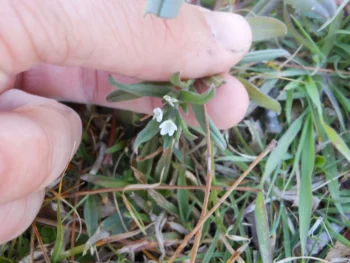
Corn Gromwell: A Hardy Annual for Informal Gardens
If you’re looking for a low-maintenance annual that can handle tough growing conditions, corn gromwell (Buglossoides arvensis) might catch your eye. This unassuming little plant has quietly made itself at home across North America, though it originally hails from Europe and western Asia. While it won’t win any beauty contests, corn gromwell has some qualities that make it worth considering for certain garden situations.
Getting to Know Corn Gromwell
Corn gromwell goes by the botanical name Buglossoides arvensis, and you might also see it listed under its former name, Lithospermum arvense. This annual plant is part of the borage family, and true to its heritage, it has that characteristic rough, somewhat bristly texture that many plants in this family share.
As a non-native species, corn gromwell has established itself throughout most of the United States and several Canadian provinces, including Alabama, Arkansas, California, Colorado, Connecticut, Delaware, Florida, Georgia, Idaho, Illinois, Indiana, Iowa, Kansas, Kentucky, Louisiana, Maine, Maryland, Massachusetts, Michigan, Minnesota, Mississippi, Missouri, Montana, Nebraska, New Hampshire, New Jersey, New York, North Carolina, North Dakota, Ohio, Oklahoma, Oregon, Pennsylvania, Rhode Island, South Carolina, South Dakota, Tennessee, Texas, Utah, Vermont, Virginia, Washington, West Virginia, Wisconsin, Wyoming, as well as British Columbia, Manitoba, Nova Scotia, Ontario, and Quebec.
- Species observed
- No observations
What Does Corn Gromwell Look Like?
Don’t expect corn gromwell to be the star of your flower border. This plant is more about function than flash. It produces small, white flowers in spring that are quite tiny – we’re talking less than a quarter-inch across. The real character of this plant comes from its rough, somewhat hairy leaves and its low-growing, spreading habit.
The flowers may be small, but they do attract small bees and other beneficial insects, so there’s definitely some pollinator value here. The plant typically stays fairly low to the ground, making it more of a ground-hugging annual than a showy display piece.
Where Corn Gromwell Fits in Your Garden
Corn gromwell isn’t the plant for formal flower beds or carefully manicured landscapes. Instead, it shines in more relaxed, naturalized settings where you want something tough and reliable. Consider it for:
- Wildflower gardens or naturalized areas
- Difficult sites with poor soil
- Areas where you want low-maintenance ground cover
- Informal cottage garden settings
- Disturbed sites that need quick coverage
Growing Conditions and Care
One of corn gromwell’s best qualities is its adaptability. This plant is remarkably unfussy about growing conditions, which explains how it’s managed to establish itself so widely. It thrives in USDA hardiness zones 3 through 9, handling both cold winters and hot summers with ease.
For growing conditions, corn gromwell prefers:
- Full sun to partial shade
- Well-draining soil (it’s not picky about soil type)
- Moderate to dry conditions once established
- Minimal fertilization – it actually prefers lean soils
The beauty of this annual is that it requires virtually no care once established. It’s drought tolerant, doesn’t need regular feeding, and will often self-seed for the following year. Just scatter seeds in early spring or let existing plants drop their seeds naturally.
Should You Plant Corn Gromwell?
The decision to plant corn gromwell really depends on what you’re trying to achieve in your garden. If you want a low-maintenance annual for difficult sites or naturalized areas, it can certainly fill that role. However, since it’s not native to North America, you might want to consider native alternatives that provide similar benefits while supporting local ecosystems.
Some native alternatives to consider include:
- Wild bergamot (Monarda fistulosa) for pollinator gardens
- Little bluestem (Schizachyrium scoparium) for naturalized areas
- Native annual sunflowers (Helianthus species) for informal settings
- Regional native wildflower mixes suited to your specific area
The Bottom Line
Corn gromwell is a plant that does its job quietly and efficiently. It’s not going to wow visitors with stunning blooms, but it will provide reliable coverage in challenging spots and offer some benefits to small pollinators. While it’s not problematic as an introduced species, choosing native alternatives when possible helps support local wildlife and maintains the character of regional landscapes.
If you do decide to grow corn gromwell, you’ll find it to be one of the most undemanding annuals you can plant. Sometimes, that’s exactly what a garden needs – a plant that just gets on with the business of growing without requiring much fuss from the gardener.