Non-native Plants

Creeping Buttercup

Ranunculus repens

USDA symbol: RARE3

perennial forb

Alaska: non-native, naturalized
Canada: non-native, naturalized
Greenland: non-native, naturalized
Hawaii: non-native, naturalized
Lower 48 states: non-native, naturalized
St. Pierre and Miquelon: non-native, naturalized

If you’ve ever spotted those cheerful, glossy yellow flowers carpeting a damp meadow or lawn edge, you’ve likely encountered creeping buttercup (Ranunculus repens). This European native has made itself quite at home across North America, and while it brings undeniable spring beauty, it comes with some important considerations for gardeners. ...

Creeping Buttercup: A Bright but Potentially Problematic Perennial

If you’ve ever spotted those cheerful, glossy yellow flowers carpeting a damp meadow or lawn edge, you’ve likely encountered creeping buttercup (Ranunculus repens). This European native has made itself quite at home across North America, and while it brings undeniable spring beauty, it comes with some important considerations for gardeners.

What Is Creeping Buttercup?

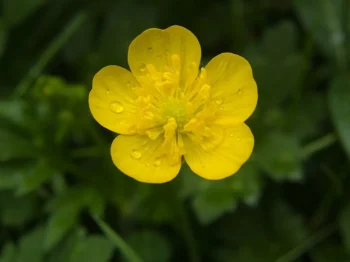
Creeping buttercup is a perennial forb that lives up to its name with an impressive ability to spread. This low-growing plant reaches about 2 feet in height and produces those classic bright yellow, five-petaled flowers that seem to glow in spring sunlight. The deeply divided, palmate leaves create an attractive backdrop, though the plant’s claim to fame is definitely its prostrate, spreading growth habit.

Originally from Europe and western Asia, this buttercup has established itself across an impressive range, thriving in states and provinces from Alaska to Alabama, and from British Columbia to Newfoundland. It’s particularly well-adapted to areas with medium to high moisture levels.

  • Species observed
  • No observations

The Good, The Bad, and The Spreading

Let’s start with the positives: creeping buttercup is genuinely beautiful when in bloom during mid-spring. Those glossy yellow flowers are magnets for bees, flies, and other pollinators seeking nectar and pollen. The plant is also remarkably adaptable, tolerating shade and thriving in conditions where other plants might struggle.

However, there’s a significant but coming. This plant spreads rapidly through stolons (above-ground runners), and once established, it can be challenging to control. Its moderate toxicity also means it’s not the best choice around grazing animals or curious pets.

Growing Conditions and Care

If you’re considering growing creeping buttercup (or trying to understand why it’s thriving in your yard), here’s what it loves:

  • Moisture: This plant has low drought tolerance and prefers consistently moist conditions
  • Soil: Adapts well to fine and medium-textured soils with medium fertility requirements
  • pH: Prefers slightly acidic to neutral soils (5.6-7.2)
  • Light: Shade tolerant, making it successful in areas where other plants struggle
  • Temperature: Hardy in USDA zones 5-9, tolerating temperatures down to -28°F

The plant has a rapid growth rate and can spread both by seed and vegetatively, though vegetative spread is relatively slow compared to seed dispersal.

Should You Plant It?

Here’s where things get interesting. While creeping buttercup isn’t officially classified as invasive in most regions, its aggressive spreading habit and non-native status give many native plant enthusiasts pause. If you’re looking for that bright yellow spring color and pollinator appeal, consider these native alternatives instead:

  • Wild ginger for shade and moisture
  • Marsh marigold for wet, sunny spots
  • Native violets for ground cover with spring flowers
  • Golden ragwort for yellow spring blooms

Managing Existing Populations

If creeping buttercup has already claimed territory in your landscape, removal can be challenging due to its stoloniferous growth. Hand-pulling is most effective when soil is moist, and you’ll need to remove all root fragments. Multiple treatments over several seasons are typically necessary for complete control.

Final Thoughts

Creeping buttercup occupies an interesting middle ground in the gardening world. It’s undeniably attractive and provides some ecological benefits, but its aggressive nature and non-native status make it a questionable choice for intentional planting. If you appreciate its spring show in naturalized areas, that’s perfectly understandable – just be aware of its spreading potential and consider native alternatives for new plantings.

Remember, the best gardens often balance beauty with ecological responsibility, and there are plenty of native options that can provide similar aesthetic appeal without the potential drawbacks of aggressive spreading.

Ranunculus repens is also known as...

Often we refer to plants by their common names. When shopping for plants the scientific name is the best way to positively identify the plant species you desire. But some plants have more than one name! While it doesn't happen often, nurseries might display one name while you're searching for another. Ranunculus repens is also known as:

Ranunculus repens var. degeneratus | USDA symbol: RARED
Ranunculus repens var. erectus DC. | USDA symbol: RAREE
Ranunculus repens var. glabratus DC. | USDA symbol: RAREG
Ranunculus repens var. linearilobus DC. | USDA symbol: RAREL
Ranunculus repens var. pleniflorus | USDA symbol: RAREP
Ranunculus repens var. typicus | USDA symbol: RARET3
Ranunculus repens var. villosus | USDA symbol: RAREV

Why do some plants have more than one name? Over time plant species may be renamed for a few reasons:

  1. Botanists in different regions named the same plant without knowing it had already been classified.
  2. A species was reclassified after scientific advances in, for example, DNA analysis.
  3. Slight variations within a species are sometimes mistakenly identified as entirely new species.

Wetland Status

The rule of seasoned gardeners and landscapers is to choose the "right plant for the right place" — matching plants to their ideal growing conditions, so they'll thrive with less care and fewer inputs. But the simplicity of this catchphrase conceals how tricky plant selection can be if you don't have the right information. While tags on nursery plants list watering requirements, there's more to the story.

Knowing a plant's wetland status can simplify the process by revealing the interaction between plants, water, and soil. You might be surprised to learn that popular landscape plants are wetland species! And what may be a wetland plant in one area, in another it might thrive in drier conditions. The table below gives insight into the preferred growing conditions of this plant throughout its geographical distribution.

Region
Preferred Habitat

Alaska ()

Facultative

Arid West (AZ, CA, CO, ID, MT, NV, NM, OR, TX, UT, WA, WY)

Facultative

Atlantic and Gulf Coastal Plain (AL, AR, DC, DE, FL, GA, IL, KY, LA, MD, MS, MO, NC, NJ, OK, PA, SC, TN, TX, VA)

Facultative

Eastern Mountains and Piedmont (AL, AR, DC, DE, GA, IL, IN, KS, KY, MD, MO, NC, NJ, NY, OH, OK, PA, SC, TN, VA, WV)

Facultative

Great Plains (CO, KS, MN, MT, NE, NM, ND, OK, SD, TX, WY)

Facultative Wetland

Hawaii ()

Facultative

Midwest (IL, IN, IA, KS, KY, MI, MN, MO, NE, ND, OK, OH, SD, WI)

Facultative

Northcentral & Northeast ()

Facultative

Western Mountains, Valleys, and Coast (AZ, CA, CO, ID, MT, NV, NM, OR, SD, UT, WA, WY)

Facultative
Wetland Glossary
Obligate Wetland
Facultative Wetland
Facultative
Facultative Upland
Obligate Upland
Almost always occurs in wetlands
Usually occurs in wetlands but may occur in non-wetlands
Can occur in wetlands and non-wetlands
Usually occurs in non-wetlands but may occur in wetlands
Almost never occurs in wetlands

Classification

Group: Dicot
Kingdom: Plantae - Plants
Subkingdom: Tracheobionta - Vascular plants
Superdivision: Spermatophyta - Seed plants
Division: Magnoliophyta - Flowering plants
Class: Magnoliopsida - Dicotyledons
Subclass: Magnoliidae
Order: Ranunculales
Family: Ranunculaceae Juss. - Buttercup family
Genus: Ranunculus L. - buttercup

Species: Ranunculus repens L. - creeping buttercup

Plant data source: USDA, NRCS 2025. The PLANTS Database. https://plants.usda.gov,. 2/25/2025. National Plant Data Team, Greensboro, NC USA