Creeping Meadow Foxtail: A Hardy Grass for Wet Areas (But Maybe Not Your First Choice)
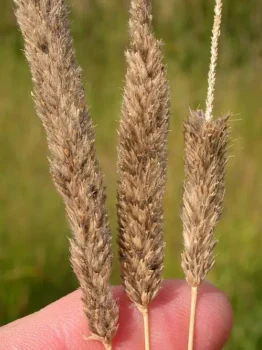
If you’ve ever wandered through a soggy meadow or along a stream bank and noticed tall, somewhat coarse grass with yellowish flower spikes, you might have encountered creeping meadow foxtail (Alopecurus arundinaceus). This perennial grass has quite the story to tell – and quite the personality to match.
The Basics: What Exactly Is Creeping Meadow Foxtail?
Creeping meadow foxtail is a robust perennial grass that’s not exactly what you’d call a garden prima donna. Standing up to 3 feet tall, this rhizomatous grass spreads rapidly underground, creating dense colonies wherever it takes hold. You might also see it listed under its synonym Alopecurus ventricosus in older references, but don’t let the name confusion fool you – it’s the same plant.
The grass produces fine-textured green foliage that turns dense in summer but becomes more porous in winter. Its yellow flowers bloom in mid-spring, though they’re not particularly showy – this isn’t the plant you choose for curb appeal.
Where Does It Call Home?
Here’s where things get interesting: creeping meadow foxtail isn’t a North American native. Originally from Europe and Asia, this grass has made itself at home across a surprising range of locations in North America. You’ll find it growing in Alberta, Manitoba, Northwest Territories, and Newfoundland in Canada, plus states like Arizona, Colorado, Idaho, Kentucky, Montana, Nebraska, North Dakota, South Dakota, Utah, Washington, and Wyoming.
- Species observed
- No observations
In Canada, it’s considered a waif – basically a plant that shows up but doesn’t stick around long-term. In the United States, however, it’s naturalized and reproduces on its own in the wild.
The Wet Feet Factor
If there’s one thing creeping meadow foxtail loves, it’s moisture. This grass is classified as facultative to facultative wetland across most regions, meaning it usually hangs out in wetlands but can tolerate drier conditions when needed. Its wetland status varies slightly by region:
- Arid West and Western Mountains: Facultative (equally at home in wet or dry spots)
- Eastern Mountains, Great Plains, and Midwest: Facultative Wetland (prefers the soggy life)
Growing Conditions: What Makes This Grass Tick
Creeping meadow foxtail is surprisingly adaptable, which explains its wide distribution. Here’s what it needs to thrive:
- Soil: Prefers fine to medium-textured soils but adapts to various conditions
- pH: Tolerates a range from 5.5 to 8.4
- Moisture: Medium moisture use with high tolerance for waterlogged conditions
- Temperature: Hardy down to -43°F (roughly USDA zones 2-8)
- Precipitation: Thrives with 18-70 inches annually
- Salt tolerance: High – great near roadsides or coastal areas
- Shade: Intolerant – needs full sun
Should You Plant It? The Honest Truth
Let’s be real: creeping meadow foxtail isn’t winning any beauty contests. Its rapid growth rate and rhizomatous spreading habit make it more of a utilitarian choice than an ornamental one. Here’s when it might make sense:
Reasons You Might Consider It:
- Erosion control in wet areas
- Wetland restoration projects
- Areas where other grasses struggle with wet conditions
- Need for quick ground cover in challenging spots
Reasons to Think Twice:
- Not native to North America
- Limited ornamental value
- Aggressive spreading habit
- Minimal benefits for pollinators (it’s wind-pollinated)
- Unknown wildlife benefits
Better Native Alternatives
Before you commit to creeping meadow foxtail, consider these native alternatives that offer similar wet-soil tolerance with better ecological benefits:
- Blue joint grass (Calamagrostis canadensis)
- Rice cutgrass (Leersia oryzoides)
- Fowl mannagrass (Glyceria striata)
- Prairie cordgrass (Spartina pectinata)
If You Decide to Grow It: Planting and Care
Growing creeping meadow foxtail is refreshingly straightforward – perhaps too straightforward:
Planting:
- Start from seed (786,064 seeds per pound – you won’t run short!)
- Plant in spring when soil is consistently moist
- Seeds require at least 30 frost-free days to establish
- Expect slow initial seed spread but rapid vegetative spread once established
Care:
- Minimal care required once established
- Active growth period in spring and summer
- Rapid regrowth after cutting or grazing
- Medium fertility requirements
- High fire tolerance
The Bottom Line
Creeping meadow foxtail is like that reliable friend who’s not the life of the party but shows up when you need them. It’s tough, adaptable, and gets the job done in wet, challenging conditions where other plants might fail. However, given its non-native status and limited ecological benefits, it’s worth exploring native alternatives first.
If you’re dealing with a particularly challenging wet site where natives have failed, or if you’re working on a large-scale erosion control project, creeping meadow foxtail might earn its place. Just remember – once it’s established, it’s there to stay, spreading steadily via those persistent rhizomes.
Sometimes the most honest advice is the simplest: there are probably better choices for most garden situations, but this grass certainly knows how to survive and thrive in the spots where others can’t.