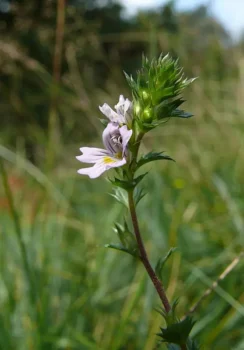
Drug Eyebright: A Charming European Annual for Your Garden
If you’ve ever stumbled across tiny white flowers with delicate purple markings in a meadow or naturalized area, you might have encountered drug eyebright (Euphrasia stricta). This petite annual has quietly made itself at home across much of North America, bringing a touch of Old World charm to gardens and wild spaces alike.
What is Drug Eyebright?
Drug eyebright is a small annual forb – essentially a non-woody plant that completes its entire life cycle in one growing season. Originally hailing from Europe, this diminutive beauty has established itself as a naturalized resident across many northeastern and north-central regions of North America. While it’s not a native species, it’s not considered invasive either, making it a somewhat neutral addition to the gardening conversation.
Where You’ll Find It Growing
Drug eyebright has spread across a impressive range of states and provinces, including New Brunswick, Nova Scotia, Ontario, Prince Edward Island, Quebec, Illinois, Maine, Massachusetts, Michigan, New Hampshire, New York, Pennsylvania, Rhode Island, Vermont, and Wisconsin. This wide distribution speaks to its adaptability and resilience.
- Species observed
- No observations
Garden Appeal and Landscape Role
Don’t expect dramatic garden drama from drug eyebright – its beauty lies in subtlety. The small white flowers, adorned with purple markings and yellow throats, create a delicate carpet effect when grown in groups. At just a few inches tall, it works wonderfully as:
- Ground cover in naturalized areas
- Filler in wildflower gardens
- Addition to meadow-style plantings
- Accent in rock gardens or between stepping stones
This plant shines in informal garden settings where its modest stature and self-seeding nature can be appreciated rather than overwhelmed by showier companions.
Growing Conditions and Care
Drug eyebright is refreshingly low-maintenance, which explains its success as a naturalized species. Here’s what it prefers:
- Sunlight: Partial shade to full sun
- Soil: Moist, well-drained soils
- Moisture: Consistent moisture without waterlogging
- Hardiness: Thrives in USDA zones 3-8
As a facultative upland plant, drug eyebright usually grows in non-wetland areas but can tolerate occasional wet conditions, making it quite versatile in the landscape.
Planting and Propagation Tips
Since drug eyebright is an annual, it relies on self-seeding to return each year. Here are some tips for success:
- Scatter seeds in late fall or early spring
- Lightly rake seeds into soil surface
- Keep soil consistently moist during germination
- Allow plants to go to seed for natural regeneration
- Minimal fertilization needed – too much nutrition can reduce flowering
Wildlife and Pollinator Benefits
While drug eyebright may be small, it pulls its weight in supporting local ecosystems. The tiny flowers attract small bees, hover flies, and other diminutive pollinators that might be overlooked by larger blooms. Its seeds may also provide food for small birds and insects.
Should You Grow Drug Eyebright?
Drug eyebright occupies an interesting middle ground in the native plant conversation. While it’s not native to North America, it’s also not problematically invasive. If you’re drawn to its delicate charm and have an appropriate spot in your garden, there’s no compelling reason to avoid it.
However, if you’re specifically focused on supporting native ecosystems, consider these native alternatives that offer similar benefits:
- Wild bergamot (Monarda fistulosa)
- White wild indigo (Amorpha alba)
- Small white aster (Symphyotrichum ericoides)
- Partridge pea (Chamaecrista fasciculata)
The Bottom Line
Drug eyebright is a gentle, unassuming plant that asks for little and gives back in its own quiet way. Whether you choose to include it in your garden or not, you can appreciate its subtle beauty when you encounter it in the wild – a small reminder that sometimes the most overlooked plants have their own special place in the landscape.