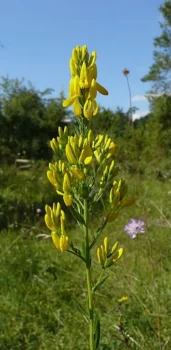
Dyer’s Greenweed: A European Import with Golden Blooms
If you’ve ever wondered about those cheerful yellow flowers brightening up roadsides and meadows in late spring, you might be looking at Dyer’s greenweed (Genista tinctoria). This perennial shrub, also known as dyer’s broom, woadwaxen, or woodwaxen, has quite the story to tell – and it’s not originally from around here.
What Exactly Is Dyer’s Greenweed?
Dyer’s greenweed is a multi-stemmed woody shrub that typically reaches 4-5 feet in height, though it can occasionally grow taller under the right conditions. As a perennial, it comes back year after year, developing a network of stems that arise from or near the ground. The plant gets its name from its historical use in creating yellow dye – quite the claim to fame!
Where Did It Come From and Where Is It Now?
This sunny shrub hails from Western and Central Europe, extending into parts of Asia Minor. However, it’s made itself quite at home in North America, where it’s considered a non-native species that reproduces on its own in the wild. You can now find Dyer’s greenweed established across numerous states and provinces, including Nova Scotia, Ontario, Connecticut, Quebec, District of Columbia, Maine, Maryland, Massachusetts, Michigan, Mississippi, New Jersey, New York, Ohio, Rhode Island, Vermont, Virginia, Washington, and Wisconsin.
- Species observed
- No observations
The Good, the Bad, and the Bloomy
Let’s be honest about what you’re getting into with Dyer’s greenweed. On the plus side, this shrub offers:
- Bright yellow, pea-like flowers that bloom in dense clusters from late spring to early summer
- Attractive to bees and other pollinators during its flowering period
- Low maintenance once established
- Tolerance for poor soils and drought conditions
- Hardy in USDA zones 4-8
However, since it’s not native to North America, it won’t provide the same ecological benefits as indigenous plants. While it’s not currently listed as invasive or noxious, it does self-seed and can spread on its own.
Growing Dyer’s Greenweed Successfully
If you decide to give this European transplant a try, here’s what it needs to thrive:
Location and Light: Choose a spot with full sun exposure. Dyer’s greenweed really loves soaking up those rays.
Soil Requirements: The good news? This plant isn’t picky about soil quality. It actually tolerates poor, well-drained soils quite well. Just make sure drainage is adequate – soggy roots are not its friend.
Watering: Once established, Dyer’s greenweed is quite drought tolerant. Water regularly during its first year, then let nature take over in most cases.
Maintenance: This is where the plant really shines – it’s refreshingly low maintenance. Occasional pruning to maintain shape is about all it needs. Keep an eye out for self-seeding if you want to control its spread.
Garden Design Ideas
Dyer’s greenweed works well in cottage gardens, naturalized landscapes, or areas where you’re comfortable incorporating non-native plants. Its upright, branching habit and golden blooms can add a cheerful pop of color to informal garden settings.
Consider Native Alternatives
If you’re leaning toward supporting local ecosystems, consider these native alternatives that offer similar yellow blooms:
- Wild senna (Senna hebecarpa)
- Spicebush (Lindera benzoin)
- Wild indigo species (Amorpha spp.)
- Native honeysuckles (Lonicera spp.)
The Bottom Line
Dyer’s greenweed can be an attractive, low-maintenance addition to the right garden setting. While it’s not native and won’t provide the same ecological benefits as indigenous plants, it’s also not considered problematic enough to avoid entirely. If you choose to plant it, enjoy those golden blooms and easy care requirements – just keep an eye on its tendency to self-seed and spread naturally.
Whether you go with Dyer’s greenweed or choose a native alternative, the most important thing is creating a garden space that brings you joy while being mindful of your local ecosystem.