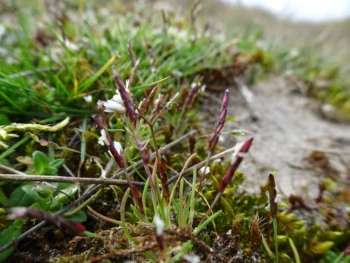
Early Sandgrass: The Tiny European Immigrant You’ve Probably Never Heard Of
Meet early sandgrass (Mibora minima), one of North America’s most obscure non-native grasses. If you’re expecting a showy ornamental that will transform your landscape, you might want to keep reading – this little European immigrant has a very different story to tell.
What Exactly Is Early Sandgrass?
Early sandgrass is a tiny annual grass that originally hails from Europe. Despite what some databases might suggest, this diminutive plant is actually an annual, not a perennial. It belongs to the same family as more familiar grasses, but you’d need a magnifying glass to truly appreciate its delicate structure. The plant rarely grows taller than a few inches, making it one of the smallest grasses you’ll encounter.
You might also see it referenced by its scientific synonym, Agrostis minima, in older botanical texts, but Mibora minima is the currently accepted name.
Where You’ll Find It (If You Look Really Hard)
In North America, early sandgrass has established itself in just two states: Massachusetts and New York. Even there, it’s incredibly rare and easy to overlook. This non-native species has managed to naturalize in these limited areas, reproducing on its own without human intervention.
- Species observed
- No observations
Should You Plant Early Sandgrass?
Here’s the honest answer: probably not. While early sandgrass isn’t considered invasive or problematic, it offers very little for the home gardener. Here’s why:
- It’s virtually invisible in the landscape due to its tiny size
- It provides minimal aesthetic appeal
- You won’t find it at your local nursery – it’s not commercially available
- Its wildlife benefits are negligible compared to native alternatives
- It offers no significant pollinator support
If You’re Set on Small Grasses
If you’re drawn to the idea of petite grasses in your garden, consider these native alternatives that actually provide ecological benefits:
- Little bluestem (Schizachyrium scoparium) – gorgeous fall color and wildlife habitat
- Buffalo grass (Bouteloua dactyloides) – drought-tolerant native lawn alternative
- Pennsylvania sedge (Carex pensylvanica) – excellent native groundcover
Growing Conditions (If You Somehow Find Seeds)
On the off chance you encounter early sandgrass in the wild or somehow obtain seeds, it prefers:
- Sandy, poor soils
- Full sun exposure
- Dry conditions
- USDA hardiness zones 6-9 (estimated based on current distribution)
The plant typically germinates in fall or early spring, grows quickly, sets seed, and dies – all within a few months.
The Bottom Line
Early sandgrass is more of a botanical curiosity than a garden plant. While it’s not harmful to grow, it won’t add much to your landscape either. Instead of seeking out this tiny European immigrant, why not explore the amazing diversity of native grasses that can provide beauty, wildlife habitat, and ecological benefits right in your own backyard?
Your local native plant society or extension office can help you discover native grass species that are perfectly adapted to your specific region – and actually available for purchase!