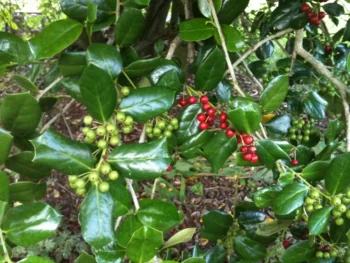
English Holly: A Classic Evergreen with Holiday Charm
When most people think of holiday decorations, the glossy green leaves and bright red berries of English holly immediately come to mind. This iconic evergreen shrub, scientifically known as Ilex aquifolium, has been gracing gardens and homes for centuries with its distinctive spiny foliage and festive appearance.
What is English Holly?
English holly is a perennial, multi-stemmed woody shrub that typically grows 13-16 feet tall, though it can reach greater heights under ideal conditions. This evergreen beauty maintains its glossy, dark green leaves year-round, making it a valuable addition to gardens seeking winter interest. The plant is dioecious, meaning you’ll need both male and female plants if you want those coveted bright red berries that appear in fall and persist through winter.
Native Status and Geographic Distribution
English holly is not native to North America. Originally from western and southern Europe, northwest Africa, and southwest Asia, this species has been introduced to North America and now grows wild in several regions. You can find established populations in British Columbia, Ontario, California, Hawaii, New Jersey, Oregon, Virginia, and Washington, where it reproduces spontaneously without human intervention.
- Species observed
- No observations
Should You Plant English Holly in Your Garden?
English holly offers several appealing qualities that make it attractive to gardeners:
- Year-round evergreen foliage provides structure and color in winter landscapes
- Attractive glossy leaves with distinctive spiny edges
- Bright red berries add festive color (female plants only)
- Excellent for formal hedging and screening
- Tolerates coastal conditions well
- Provides some wildlife value through berries and nesting sites
However, as a non-native species, you might consider native alternatives that provide similar benefits while supporting local ecosystems. Native holly species like American holly (Ilex opaca) or winterberry (Ilex verticillata) can offer comparable aesthetic appeal with greater ecological value.
Growing Conditions and Care
English holly is relatively easy to grow once established and thrives in USDA hardiness zones 6-9. Here’s what this adaptable shrub prefers:
- Light: Partial shade to full sun (tolerates shade well)
- Soil: Well-drained, slightly acidic to neutral soil
- Water: Moderate moisture; drought tolerant once established
- Space: Allow adequate room for mature size
Planting and Care Tips
For successful English holly cultivation, follow these guidelines:
- Plant in spring or fall when temperatures are mild
- Dig a hole twice as wide as the root ball but no deeper
- Apply 2-3 inches of mulch around the base, keeping it away from the trunk
- Water regularly the first year to establish roots
- Prune in late winter to maintain shape and remove dead branches
- Plant both male and female specimens nearby if you want berries
Pollinator and Wildlife Benefits
While not a native species, English holly does provide some ecological value. The small, white spring flowers offer nectar for bees and other pollinators. Birds appreciate the bright red berries as a winter food source, and the dense foliage can provide nesting sites and shelter for various wildlife species.
Landscape Uses
English holly works well in various garden settings:
- Formal hedge or privacy screen
- Foundation plantings
- Specimen tree in mixed borders
- Woodland gardens
- Coastal landscapes
- Winter interest gardens
Wetland Considerations
English holly has a Facultative Upland wetland status across all regions where it grows, meaning it usually occurs in non-wetland areas but may occasionally be found in wetland edges. This makes it suitable for most typical garden situations.
The Bottom Line
English holly is an attractive, low-maintenance evergreen that can add year-round structure and seasonal color to your landscape. While it’s not native to North America, it’s generally well-behaved in garden settings. If you’re looking to support local ecosystems, consider native holly alternatives, but if you’re drawn to the classic appearance of English holly, it can be a beautiful addition to the right garden setting.