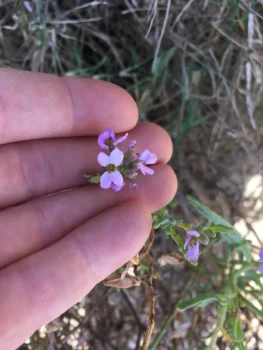
European Searocket: A Hardy Coastal Ground Cover for Sandy Soils
If you’re battling sandy, salty soil in your coastal garden, European searocket (Cakile maritima) might just be the tough little plant you’ve been looking for. This resilient annual forb has made itself quite at home along North American coastlines, offering a practical solution for challenging seaside growing conditions.
What Is European Searocket?
European searocket is a low-growing, sprawling plant that belongs to the mustard family. True to its name, this hardy species originally hails from European and Mediterranean coastlines but has established itself across various North American coastal regions. It’s an annual plant, meaning it completes its entire life cycle in one growing season, though it readily self-seeds to return year after year.
The plant forms a mat-like ground cover with succulent, blue-green leaves that help it conserve water in harsh coastal conditions. Its small, four-petaled flowers range from pale purple to white and appear throughout the growing season.
Where Does It Grow?
European searocket has established populations across a wide geographic range, including Alabama, British Columbia, California, Maryland, New Jersey, New York, North Carolina, Oregon, Pennsylvania, Texas, Virginia, and Washington. It thrives in coastal environments where many other plants struggle to survive.
- Species observed
- No observations
Important Considerations: Non-Native Status
Before adding European searocket to your garden, it’s important to know that this species is not native to North America. While it reproduces spontaneously in the wild and has become naturalized in many areas, gardeners should consider native alternatives first. Native coastal plants like American beachgrass, seaside goldenrod, or beach pea can provide similar benefits while supporting local ecosystems.
Why Gardeners Choose European Searocket
Despite its non-native status, European searocket offers several practical benefits for coastal gardeners:
- Exceptional salt tolerance: Thrives in salty conditions that kill most other plants
- Erosion control: Its spreading growth habit helps stabilize sandy soils
- Low maintenance: Requires minimal care once established
- Drought resistant: Succulent leaves help it survive with little water
- Pollinator friendly: Small flowers attract bees, flies, and other coastal pollinators
Growing Conditions and Care
European searocket is remarkably adaptable and can grow in conditions that would challenge most garden plants:
- Soil: Prefers sandy, well-draining soils but tolerates poor, rocky conditions
- Sun exposure: Full sun is best
- Water: Drought tolerant once established; actually prefers drier conditions
- Climate: Hardy across USDA zones 3-10, particularly in coastal areas
Planting and Maintenance Tips
Growing European searocket is refreshingly straightforward:
- Seeding: Direct sow seeds in spring after the last frost
- Spacing: Seeds can be scattered broadly as plants will find their preferred spots
- Watering: Water lightly until germination, then reduce watering significantly
- Fertilizing: Unnecessary and potentially harmful – this plant thrives in poor soils
- Self-seeding: Allow some plants to go to seed for natural propagation
Wetland Adaptability
One of European searocket’s most impressive traits is its versatility regarding moisture conditions. It has a facultative wetland status, meaning it can thrive in both wetland and upland conditions. This flexibility makes it particularly valuable for transitional coastal areas where water levels may fluctuate.
Best Garden Applications
European searocket works well in several landscape situations:
- Coastal erosion control projects
- Rock gardens with sandy soil
- Xeriscapes and drought-tolerant landscapes
- Seaside cottage gardens
- Areas where salt spray is an issue
Consider Native Alternatives
While European searocket can be a practical choice for challenging coastal conditions, consider these native alternatives that provide similar benefits:
- American beachgrass (Ammophila breviligulata)
- Seaside goldenrod (Solidago sempervirens)
- Beach pea (Lathyrus japonicus)
- Sea rocket (Cakile edentula) – a native relative
The Bottom Line
European searocket offers a practical solution for gardeners dealing with challenging coastal conditions. While its non-native status means it shouldn’t be your first choice, it can be a reasonable option where native plants struggle to establish. If you do choose to grow it, be mindful of its self-seeding nature and consider incorporating native coastal plants into your landscape design as well.
Remember, the best garden is one that works with your local conditions while supporting the broader ecosystem – and sometimes that means finding the right balance between practical solutions and ecological responsibility.