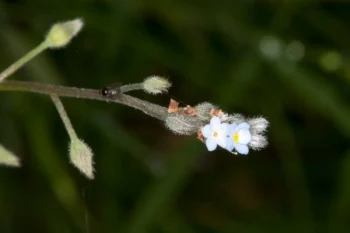
Field Forget-Me-Not: A Delicate European Beauty in North American Gardens
If you’ve ever stumbled across tiny blue flowers dotting a meadow or garden edge, you might have encountered the charming field forget-me-not (Myosotis arvensis). This petite annual has quietly made itself at home across much of North America, bringing its understated European elegance to our landscapes.
Getting to Know Field Forget-Me-Not
Field forget-me-not goes by its botanical name Myosotis arvensis, and you might occasionally see it listed under the synonym Myosotis scorpioides var. arvensis. As a member of the forb family, it’s a non-woody herbaceous plant that completes its entire life cycle in just one growing season.
Originally hailing from Europe and western Asia, this little wanderer has established itself as a non-native species that reproduces and persists throughout Canada, Greenland, the lower 48 states, and St. Pierre and Miquelon. You’ll find it growing wild in places ranging from Alberta to Wyoming, and from Newfoundland down to South Carolina.
- Species observed
- No observations
What Makes It Special (Or Not So Special)
Let’s be honest – field forget-me-not isn’t going to win any most spectacular garden flower awards. Its blooms are tiny (we’re talking 2-3mm across), but what they lack in size, they make up for in delicate charm. The small blue flowers feature crisp white centers and appear in branching clusters from spring through early summer.
This plant typically grows as a low-spreading ground cover, making it suitable for:
- Cottage gardens seeking a naturalized look
- Wildflower meadows and prairies
- Informal landscape areas
- Edges of garden beds where self-seeding is welcome
Growing Conditions and Care
One of field forget-me-not’s best qualities is its easygoing nature. This adaptable annual thrives in USDA hardiness zones 3-9, though as an annual, winter hardiness isn’t really a concern.
For growing conditions, field forget-me-not prefers:
- Moist, well-drained soils (though it’s quite tolerant of various soil types)
- Full sun to partial shade
- Areas where it can self-seed and naturalize
The plant’s wetland status varies by region. In some areas like the Eastern Mountains and Piedmont, it almost never occurs in wetlands, while in regions like the Great Plains and Midwest, you might find it in both wet and dry locations.
Planting and Maintenance
If you decide to welcome field forget-me-not into your garden, you’ll find it refreshingly low-maintenance. The plant readily self-seeds, so once established, it tends to maintain its presence with minimal intervention from you. Simply scatter seeds in early spring, keep the area moderately moist until germination, and let nature take its course.
Wildlife and Pollinator Benefits
Those tiny blue blooms aren’t just pretty – they serve an important purpose. Field forget-me-not attracts small pollinators including bees, flies, and other beneficial insects. While the individual flowers are small, they bloom prolifically, providing a reliable nectar source throughout their flowering period.
Should You Plant It?
Here’s where things get a bit nuanced. Field forget-me-not isn’t listed as invasive or noxious, so there’s no environmental red flag preventing you from growing it. However, as a non-native species, it doesn’t provide the same ecological benefits as native alternatives.
If you’re drawn to small blue flowers and naturalized plantings, consider these native alternatives instead:
- Wild lupine (Lupinus perennis) for blue flowers
- Blue-eyed grass (Sisyrinchium species) for small, delicate blooms
- Native asters for late-season color and pollinator support
That said, if you already have field forget-me-not established or specifically want this particular plant for a cottage garden aesthetic, it’s not going to cause environmental havoc. Just be aware that it will likely self-seed and spread naturally throughout your garden.
The Bottom Line
Field forget-me-not is a charming, if unspectacular, addition to informal gardens. Its tiny blue flowers and self-seeding habit make it perfect for gardeners who appreciate a naturalized look and don’t mind a plant that makes itself at home. While it won’t provide the same ecological benefits as native species, it’s not problematic enough to avoid entirely. Consider it a pleasant, low-maintenance option for casual wildflower areas – just don’t expect it to steal the show.