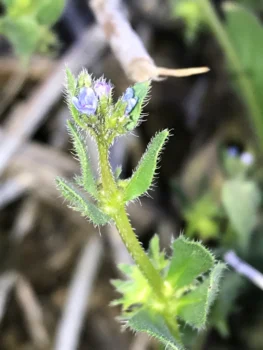
German-madwort: An Understated Annual You Probably Didn’t Know You Knew
If you’ve ever taken a close look at the weedy patches along roadsides or in disturbed areas, chances are you’ve encountered German-madwort (Asperugo procumbens) without even realizing it. This humble annual is one of those plants that flies completely under the radar, yet it has quietly made itself at home across much of North America.
What Exactly Is German-madwort?
German-madwort is a small, sprawling annual plant that belongs to the borage family. Don’t expect any showy blooms here – this plant produces tiny, almost microscopic blue flowers that you’d need a magnifying glass to truly appreciate. It’s the kind of plant that botanical purists find fascinating, but most gardeners would classify as just another weed.
Where You’ll Find It
Originally hailing from Europe and Asia, German-madwort has become a naturalized resident across a surprisingly wide range of North American locations. You can find it throughout:
- Most of the lower 48 United States, including California, Colorado, Connecticut, Delaware, Idaho, Illinois, Kansas, Maryland, Massachusetts, Minnesota, Montana, Nebraska, Nevada, New Jersey, New York, North Dakota, Ohio, Oregon, Pennsylvania, South Dakota, Utah, Virginia, Washington, and Wyoming
- Canadian provinces including Alberta, British Columbia, Manitoba, Ontario, and Yukon
- Alaska and even Greenland
This non-native species has established itself so thoroughly that it now reproduces spontaneously in the wild without any human help, persisting year after year through self-seeding.
- Species observed
- No observations
Habitat Preferences
German-madwort is decidedly a dry-land plant. Across virtually all regions where it’s found – from Alaska to the Great Plains to the Eastern Mountains – it maintains an Obligate Upland status, meaning it almost never occurs in wetlands. The only exception is in the Northcentral and Northeast regions, where it’s classified as Facultative Upland, indicating it usually prefers non-wetland areas but might occasionally pop up in wetter spots.
Should You Plant German-madwort in Your Garden?
Here’s where things get interesting. German-madwort isn’t exactly what you’d call garden-worthy. Its flowers are so tiny they’re practically invisible, and its overall appearance is rather scraggly and unremarkable. It’s more of a botanical curiosity than a landscape star.
While it’s not considered invasive or noxious, German-madwort is a non-native species. If you’re interested in supporting local ecosystems and native wildlife, you’d be better served by choosing native alternatives that provide similar ecological functions.
Native Alternatives to Consider
Instead of German-madwort, consider these native options that can thrive in similar dry, disturbed conditions:
- Native annual wildflowers suited to your region
- Indigenous borage family members if available in your area
- Local prairie or meadow species that support native pollinators and wildlife
The Bottom Line
German-madwort is one of those plants that’s more interesting from an ecological perspective than a horticultural one. It demonstrates how successfully some species can adapt and spread to new territories, establishing themselves so thoroughly they become part of the landscape’s fabric.
While there’s nothing particularly harmful about this little annual, gardeners passionate about native plant gardening will want to focus their efforts on species that truly belong in their local ecosystems. German-madwort will continue doing its quiet thing in disturbed areas and roadsides – no gardener intervention required!