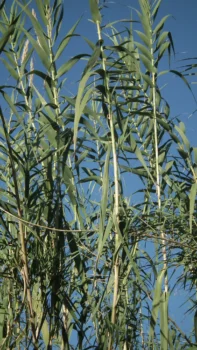
Giant Reed: Why This Towering Grass Should Stay Out of Your Garden
If you’ve ever spotted a towering wall of bamboo-like grass swaying in the breeze and thought wow, that would make a perfect privacy screen, you might be looking at giant reed (Arundo donax). But before you get any ideas about adding this impressive grass to your landscape, we need to have a serious chat about why this particular plant is more foe than friend to American gardens.
What Exactly Is Giant Reed?
Giant reed is a perennial grass that can shoot up to an impressive 9+ feet tall (and sometimes much taller in ideal conditions). This graminoid – that’s fancy talk for grass or grass-like plant – forms dense colonies through an aggressive underground rhizome system. With its thick, bamboo-like stems and feathery seed heads, it certainly looks the part of an attractive landscape plant. But looks can be deceiving.
The Big Problem: It’s an Invasive Troublemaker
Here’s where things get serious. Giant reed isn’t native to North America – it originally hails from the Mediterranean region, Asia, and parts of Africa. Since its introduction to the United States, this aggressive grass has earned itself a reputation as a major invasive species. It’s currently causing problems across a huge swath of the country, and several states have taken official action against it:
- Alabama lists it as a Category 2 invasive species
- It’s classified as invasive in North Carolina
- Wisconsin has gone so far as to prohibit it entirely
Where Giant Reed Has Spread
Unfortunately, giant reed has already established itself across much of the United States. You can currently find populations in Alabama, Arizona, Arkansas, California, Delaware, Florida, Georgia, Hawaii, Illinois, Kansas, Kentucky, Louisiana, Maryland, Mississippi, Missouri, Nevada, New Mexico, North Carolina, Oklahoma, South Carolina, Tennessee, Texas, Utah, Virginia, West Virginia, and several U.S. territories including Guam, Palau, Puerto Rico, and the Virgin Islands.
- Species observed
- No observations
Why Giant Reed Is So Problematic
Giant reed’s rapid growth rate and rhizomatous spreading habit make it a landscape nightmare once it gets established. This plant doesn’t just grow fast – it grows with a vengeance, quickly forming dense monocultures that crowd out native vegetation. Its high moisture requirements mean it often establishes along waterways, where it can alter entire ecosystems.
The plant’s wetland status varies by region, but it generally thrives in moist conditions, making it particularly troublesome for riparian areas. From the Arid West to the Atlantic and Gulf Coastal Plains, giant reed shows remarkable adaptability to different moisture regimes, which only adds to its invasive potential.
Growing Conditions (That You Should Ignore)
Just so you know what you’re NOT looking for in your garden, giant reed prefers:
- Medium to fine-textured soils
- High moisture conditions
- Full sun to intermediate shade
- Temperatures above 7°F (hardy in zones 7-11)
- Areas with 35-65 inches of annual precipitation
- Slightly acidic to neutral soils (pH 4.8-7.0)
The plant spreads rapidly through underground rhizomes and can be propagated by sprigs, which is exactly why small fragments can establish new colonies downstream or in neighboring properties.
Better Native Alternatives
Instead of risking giant reed in your landscape, consider these native alternatives that can provide similar height and screening effects without the ecological headaches:
- Native bamboos (where climatically appropriate)
- Switchgrass (Panicum virgatum) for prairie regions
- Big bluestem (Andropogon gerardii) for tall grass needs
- River oats (Chasmanthium latifolium) for shadier spots
- Native willow species for waterside plantings
The Bottom Line
While giant reed might look impressive swaying in the breeze, it’s a classic case of a plant that’s too good to be true. Its aggressive nature, invasive status, and lack of significant wildlife benefits make it a poor choice for responsible gardeners. Instead of taking a chance on this problematic grass, stick with native alternatives that will give you the height and texture you’re looking for without the environmental guilt trip.
Remember: the best gardens work with nature, not against it. Giant reed definitely falls into the against it category, so let’s leave this one off the shopping list, shall we?