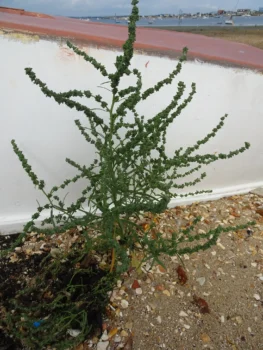
Grassleaf Orache: A Hardy Coastal Annual for Challenging Sites
If you’re dealing with salty, sandy, or otherwise challenging growing conditions, you might want to get acquainted with grassleaf orache (Atriplex littoralis). This unassuming little annual has made quite a journey from its native European and Asian coastlines to establish itself across North America, and it might just be the tough-as-nails plant your difficult garden spots have been waiting for.
What Is Grassleaf Orache?
Grassleaf orache is a low-growing annual that typically stays under 1.5 feet tall, though it can occasionally reach up to 3 feet in ideal conditions. True to its common name, this member of the goosefoot family sports narrow, grass-like leaves that give it a delicate appearance despite its hardy nature. Don’t let its modest size fool you – this little plant is incredibly resilient.
You might also see it listed under its botanical synonym Atriplex patula var. littoralis, but Atriplex littoralis is the accepted name today.
Where Does It Grow?
Originally from Europe and Asia, grassleaf orache has established itself as a non-native species across much of Canada and the northeastern United States. You’ll find it growing in British Columbia, Manitoba, New Brunswick, Nova Scotia, Ontario, Prince Edward Island, Quebec, Connecticut, Illinois, Maine, Maryland, Massachusetts, New Hampshire, New Jersey, Pennsylvania, Rhode Island, and even Puerto Rico.
- Species observed
- No observations
The plant thrives in USDA hardiness zones 3-9, making it adaptable to a wide range of climates.
Should You Plant Grassleaf Orache?
Here’s where things get interesting. Grassleaf orache isn’t native to North America, but it’s also not considered invasive in most areas where it grows. This puts it in a bit of a gray zone for native plant enthusiasts.
Reasons you might want to grow it:
- Extremely salt-tolerant – perfect for coastal gardens or areas treated with road salt
- Thrives in poor, sandy, or disturbed soils where other plants struggle
- Drought-tolerant once established
- Low-maintenance annual that often self-seeds
- Provides ground cover in challenging locations
Reasons you might skip it:
- Not native, so it doesn’t support local ecosystems as effectively as native alternatives
- Limited aesthetic appeal – it’s more functional than beautiful
- Wind-pollinated, so it offers little to pollinators
- Can self-seed aggressively in some conditions
Native Alternatives to Consider
If you’re leaning toward native options, consider these alternatives that can handle similar tough conditions:
- Four o’clock (Mirabilis multiflora) for drought tolerance
- Seaside goldenrod (Solidago sempervirens) for coastal salt tolerance
- Poverty oatgrass (Danthonia spicata) for sandy, poor soils
- Little bluestem (Schizachyrium scoparium) for drought and poor soil tolerance
How to Grow Grassleaf Orache
If you decide grassleaf orache is right for your challenging garden spots, you’ll be pleased to know it’s incredibly easy to grow.
Growing Conditions:
- Soil: Tolerates poor, sandy, salty, or disturbed soils
- Sun: Full sun to partial shade
- Water: Drought-tolerant; avoid overwatering
- pH: Adaptable to various pH levels
Planting Tips:
- Direct seed in spring after the last frost
- Barely cover seeds with soil – they need light to germinate
- Space plants 6-12 inches apart
- No soil preparation necessary in most cases
Care Instructions:
- Water occasionally during establishment, then leave it alone
- No fertilizer needed – it actually prefers poor soils
- Allow some plants to go to seed if you want it to return next year
- Remove excess seedlings if self-seeding becomes too aggressive
The Bottom Line
Grassleaf orache occupies a unique niche in the gardening world. It’s not going to win any beauty contests, but it excels where many other plants fail. If you have coastal property, areas affected by road salt, or spots with terrible soil that nothing else will grow in, this humble annual might be exactly what you need.
Just remember that as a non-native species, it won’t provide the same ecological benefits as native plants. Consider it a utilitarian choice for problem areas while prioritizing native species in your main garden beds. Sometimes the most practical plant is the one that simply survives and thrives where others cannot.