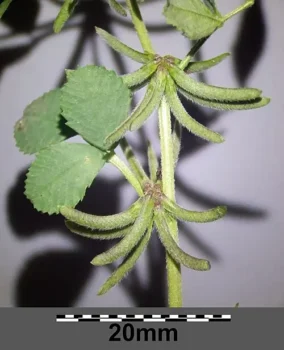
Hairy Medick: A Small but Mighty Mediterranean Annual
If you’ve ever wondered about those tiny yellow flowers popping up in disturbed soils or along roadsides, you might be looking at hairy medick (Medicago monspeliaca). This modest little annual has quietly made itself at home in parts of the United States, though it’s far from its Mediterranean origins.
What is Hairy Medick?
Hairy medick is a small annual forb that belongs to the legume family. As a forb, it’s essentially an herbaceous flowering plant without woody stems – think of it as the plant world’s equivalent of a friendly neighbor who doesn’t take up much space but contributes to the community. The hairy part of its name comes from the fine hairs that cover its stems and leaves, giving it a slightly fuzzy appearance.
This plant is also known by its scientific name Medicago monspeliaca, and historically was called Trigonella monspeliaca. The name monspeliaca refers to Montpellier, France, near where this species was first scientifically described.
Native Status and Distribution
Hairy medick is not native to North America – it’s an introduced species that has naturalized in several states. Currently, you can find it growing wild in Alabama, Maryland, Massachusetts, and New York. As a non-native plant that reproduces on its own without human intervention, it has established sustainable populations in these areas.
- Species observed
- No observations
Why Consider (or Not Consider) Hairy Medick?
As a non-native species, hairy medick presents a mixed bag for gardeners. Here’s what you should know:
Potential Benefits:
- Fixes nitrogen in the soil, improving soil fertility naturally
- Attracts small pollinators with its tiny yellow flowers
- Thrives in poor soils where other plants struggle
- Requires minimal care once established
- Self-seeds readily, creating natural ground cover
Considerations:
- Being non-native, it doesn’t provide the same ecological benefits as native alternatives
- May self-seed more aggressively than desired in some gardens
- Small stature means it won’t make a dramatic visual impact
Growing Conditions and Care
If you’re curious about growing hairy medick, it’s refreshingly low-maintenance. This tough little annual prefers:
- Sunlight: Full sun conditions
- Soil: Well-drained soils, including poor or sandy soils
- Water: Drought-tolerant once established
- pH: Adaptable to various soil pH levels
Since it’s an annual, hairy medick completes its entire life cycle in one growing season. It typically grows low to the ground, reaching only a few inches in height, making it suitable for areas where you want ground-level coverage without height.
Garden Role and Landscape Use
Hairy medick works best in naturalized areas, meadow-style gardens, or spots with challenging growing conditions. Its nitrogen-fixing ability makes it valuable for improving soil in preparation for other plants. The small yellow flowers, while not showy, add subtle color and attract beneficial insects.
This plant is particularly useful in areas where you want something growing but don’t want to fuss with high-maintenance options. Think of it as nature’s own soil conditioner with a modest floral bonus.
Native Alternatives to Consider
While hairy medick isn’t problematic, native alternatives can provide similar benefits while supporting local ecosystems more effectively. Consider these native legumes instead:
- Wild lupine (Lupinus perennis) for nitrogen fixation and pollinator support
- Partridge pea (Chamaecrista fasciculata) for annual ground cover
- Wild senna (Senna hebecarpa) for similar growing conditions
The Bottom Line
Hairy medick is one of those plants that quietly goes about its business without causing much fuss. While it’s not native and won’t support local wildlife as effectively as indigenous species, it’s not considered invasive either. If you’re drawn to its low-maintenance nature and soil-improving qualities, it can fill a niche in naturalized gardens. However, choosing native alternatives will better serve your local ecosystem while providing similar benefits.
Whether you encounter it as a volunteer in your garden or consider it for challenging spots, hairy medick represents the kind of plant that reminds us that sometimes the smallest contributors can still play a valuable role in the garden community.