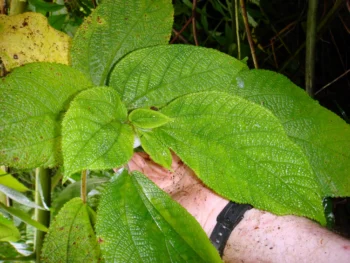
Hawai’i Lopleaf: An Introduced Shrub Worth Knowing About
Meet the Hawai’i lopleaf (Cypholophus moluccanus), a perennial shrub that’s made its home in the Hawaiian Islands despite not being a native species. While you might not find this plant at your local nursery, understanding introduced species like this one helps us appreciate the complex botanical tapestry of Hawaii’s landscapes.
What Exactly Is Hawai’i Lopleaf?
The Hawai’i lopleaf is a multi-stemmed woody shrub that typically stays under 13-16 feet tall, making it a manageable size for most garden settings. As a member of the nettle family, it shares some characteristics with other plants in this diverse group, though specific details about its appearance and growth patterns remain somewhat mysterious in horticultural literature.
You might occasionally see this plant referred to by its scientific synonym, Cypholophus macrocephalus, though Cypholophus moluccanus is the accepted name today.
Where You’ll Find It
This shrub has established itself in Hawaii, where it reproduces on its own without human intervention. It’s what botanists call a naturalized species – not originally from Hawaii, but now growing wild there.
- Species observed
- No observations
Should You Plant Hawai’i Lopleaf?
Here’s where things get interesting (and a bit complicated). While this shrub isn’t currently listed as invasive or noxious, its status as a non-native species that spreads on its own raises some questions for environmentally conscious gardeners.
The Native Alternative Route
Instead of seeking out this lesser-known introduced species, why not explore Hawaii’s amazing native shrub options? The islands are home to incredible endemic plants that:
- Support local wildlife and pollinators
- Are perfectly adapted to Hawaiian growing conditions
- Help preserve the unique character of Hawaiian ecosystems
- Often require less water and care once established
Consider native Hawaiian shrubs like ‘a’ali’i (Dodonaea viscosa), naupaka (Scaevola species), or mamaki (Pipturus albidus) for your landscape instead.
Growing Conditions and Care
Unfortunately, specific cultivation information for Cypholophus moluccanus is quite limited. What we do know is that it thrives well enough in Hawaiian conditions to reproduce and spread naturally, suggesting it’s fairly adaptable to the tropical climate there.
If you’re gardening in Hawaii and encounter this plant, it’s likely tolerant of local conditions, but without detailed horticultural information, it’s difficult to provide specific care recommendations.
The Bottom Line
While Hawai’i lopleaf isn’t necessarily a bad plant, it’s also not the most exciting choice for your garden. With so many spectacular native Hawaiian plants available, why not put your gardening energy toward species that truly belong in the islands? Your local ecosystem (and the native birds, insects, and other wildlife) will thank you for it.
If you’re passionate about supporting Hawaiian biodiversity, reach out to local native plant societies or botanical gardens – they’re fantastic resources for finding and growing the islands’ incredible endemic species.