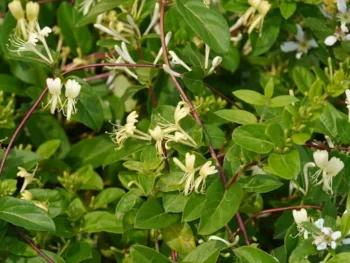
Japanese Honeysuckle: Why This Sweet-Smelling Vine Should Stay Out of Your Garden
If you’ve ever caught a whiff of that intoxicating, sweet fragrance wafting through the evening air and followed your nose to find a vine covered in tubular white flowers, you’ve likely encountered Japanese honeysuckle (Lonicera japonica). While this perennial climbing vine might seem like a gardener’s dream with its rapid growth and heavenly scent, it’s actually a gardener’s nightmare in disguise.
What Is Japanese Honeysuckle?
Japanese honeysuckle is a vigorous twining and climbing vine that can grow both as a woody or herbaceous perennial. Despite its common name suggesting a single identity, this plant is also known by several botanical synonyms including Nintooa japonica and various varieties of Lonicera japonica. Originally hailing from East Asia, this aggressive spreader has made itself far too comfortable across North America.
The Invasion Story: Where It Doesn’t Belong
Here’s the thing about Japanese honeysuckle – it’s a non-native species that has established itself as an unwelcome guest across an enormous range. This persistent invader now grows wild in Alabama, Arizona, Arkansas, California, Ontario, Connecticut, Delaware, District of Columbia, Florida, Georgia, Hawaii, Illinois, Indiana, Kansas, Kentucky, Louisiana, Maine, Maryland, Massachusetts, Michigan, Mississippi, Missouri, Nebraska, Nevada, New Hampshire, New Jersey, New Mexico, New York, North Carolina, Ohio, Oklahoma, Pennsylvania, Rhode Island, South Carolina, Tennessee, Texas, Utah, Virginia, Washington, West Virginia, Wisconsin, and Puerto Rico.
- Species observed
- No observations
Why Japanese Honeysuckle Is a Problem
Multiple states have officially recognized Japanese honeysuckle as invasive, and some have gone so far as to prohibit its sale and planting:
- Alabama: Category 1 invasive
- Connecticut: Invasive and prohibited
- Delaware: Invasive
- Missouri: Invasive
- New Hampshire: Prohibited
- North Carolina: Invasive
- Wisconsin: Prohibited
This vine’s rapid growth rate – combined with its ability to spread both by seed and vegetatively – allows it to quickly overwhelm native plants and alter entire ecosystems.
What It Looks Like (So You Can Spot It)
Japanese honeysuckle is actually quite attractive, which is part of what makes it so problematic. Here are its key features:
- Fragrant white flowers that bloom from late spring through fall
- Tubular flowers that may yellow with age
- Dense, green foliage with coarse texture
- Black berries that are conspicuous when present
- Rapid, aggressive growth reaching about 1 foot in height but spreading extensively
- Stoloniferous growth form (spreading by underground runners)
Growing Conditions (That You Should Know to Avoid Encouraging It)
Japanese honeysuckle is frustratingly adaptable, which explains its widespread success as an invasive species. It thrives in:
- USDA hardiness zones 4-10
- Various soil types, preferring fine to medium-textured soils
- pH ranges from 4.9 to 7.8
- Both sunny and shady locations (shade tolerant)
- Areas with 24-60 inches of annual precipitation
- Temperatures as low as -13°F
Its wetland status varies by region, but it generally prefers upland areas while occasionally tolerating wetland conditions.
Wildlife Impact: Not All Benefits Are Good
While Japanese honeysuckle does provide some wildlife benefits – offering modest food sources for large animals, small mammals, and terrestrial birds (about 2-5% of their diet) and sparse cover – these benefits come at a significant cost. The plant’s aggressive nature displaces native species that would provide much more substantial and appropriate wildlife habitat and food sources.
Our Strong Recommendation: Don’t Plant It
As native gardening experts, we cannot recommend planting Japanese honeysuckle under any circumstances. Its invasive status, rapid spread, and negative impact on native ecosystems far outweigh any perceived benefits like its fragrant flowers or fast coverage.
Better Alternatives: Native Options That Actually Belong
Instead of Japanese honeysuckle, consider these native alternatives that offer similar benefits without the ecological harm:
- American groundnut (Apios americana) for fragrant flowers and climbing habit
- Coral honeysuckle (Lonicera sempervirens) for hummingbird attraction
- Wild bergamot (Monarda species) for fragrant flowers and pollinator benefits
- Virgin’s bower (Clematis virginiana) for vigorous climbing growth
If You Already Have It: Management Tips
If Japanese honeysuckle has already established itself on your property, removal requires persistence and multiple approaches. The plant’s high fire tolerance and resprout ability make it particularly challenging to eliminate. Consider consulting with local extension services or invasive species management professionals for the most effective removal strategies in your area.
Remember, the most beautiful gardens are those that work in harmony with local ecosystems rather than against them. By choosing native alternatives, you’ll create a landscape that’s not only lovely but also truly beneficial to your local wildlife and environment.