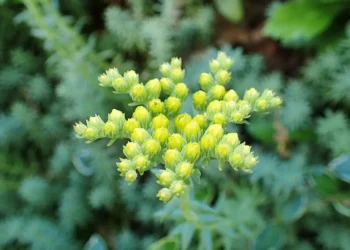
Jenny’s Stonecrop: A Hardy Ground Cover with European Charm
If you’re searching for a tough-as-nails ground cover that laughs in the face of drought and poor soil, Jenny’s stonecrop (Sedum reflexum) might just be your new garden hero. This succulent perennial has been quietly conquering rock gardens and difficult spots across North America, though it originally called the mountains of Europe home.
What is Jenny’s Stonecrop?
Jenny’s stonecrop is a low-growing, mat-forming succulent that belongs to the diverse Sedum family. You might also see it listed under its synonyms Petrosedum reflexum or Sedum rupestre in some gardening references. This herbaceous perennial spreads by creeping stems, creating dense carpets of blue-green to gray-green needle-like leaves that look almost architectural in their precision.
Where Does It Grow?
Originally from European mountain regions, Jenny’s stonecrop has established itself across parts of Canada and the United States. You’ll find naturalized populations in Ontario, Prince Edward Island, and Quebec, as well as in several U.S. states including Georgia, Illinois, Indiana, Maine, Massachusetts, New Jersey, New York, Ohio, Virginia, and Washington.
- Species observed
- No observations
Should You Plant Jenny’s Stonecrop?
Here’s where things get interesting. Jenny’s stonecrop is undeniably useful – it’s drought-tolerant, requires minimal care, and thrives in spots where other plants throw in the towel. However, since it’s not native to North America, you might want to consider some alternatives first.
The Case For Growing It:
- Extremely drought tolerant once established
- Thrives in poor, rocky soils where other plants struggle
- Provides bright yellow flowers that attract pollinators in summer
- Excellent for erosion control on slopes
- Hardy in USDA zones 3-9
- Low maintenance and long-lived
Things to Consider:
- Can spread aggressively and may outcompete native plants
- Not native to North America
- May not provide the same wildlife benefits as native alternatives
Native Alternatives to Consider
Before planting Jenny’s stonecrop, consider these native sedums that offer similar benefits: wild stonecrop (Sedum ternatum), broad-leaved stonecrop (Sedum spathulifolium), or lance-leaved stonecrop (Sedum lanceolatum), depending on your region.
Perfect Spots for Jenny’s Stonecrop
If you do choose to grow Jenny’s stonecrop, it shines in these situations:
- Rock gardens and between stepping stones
- Green roofs and extensive roof gardens
- Xeriscape and drought-tolerant landscapes
- Slopes where erosion control is needed
- Mediterranean-style gardens
- Areas with poor, sandy, or rocky soil
Growing Jenny’s Stonecrop Successfully
Light and Soil Requirements
Jenny’s stonecrop is practically bulletproof when it comes to growing conditions. It absolutely loves full sun – the more, the better. While it can tolerate some light shade, you’ll get the best color and most compact growth in bright, sunny spots.
As for soil, this plant’s motto seems to be the worse, the better. It thrives in poor, sandy, or rocky soils and actually performs better in lean conditions than in rich, fertile ground. The one non-negotiable requirement is good drainage – soggy soil is about the only thing that will reliably kill this tough cookie.
Planting and Care Tips
- Plant in spring or fall when temperatures are moderate
- Space plants 12-18 inches apart for ground cover
- Water regularly the first season, then rarely once established
- Avoid fertilizing – rich soil can make the plant leggy
- Divide clumps every 3-4 years to prevent overcrowding
- Trim back after flowering to maintain neat appearance
Maintenance and Management
One of Jenny’s stonecrop’s greatest selling points is also something to watch: it’s incredibly easy to grow and can spread enthusiastically. In ideal conditions, it may spread more than you’d like, so keep an eye on it and be prepared to divide or remove excess plants.
The good news is that it’s also easy to control – simply pull up unwanted sections (they come up easily) or cut back spreading areas with pruners.
Pollinator Benefits
While not native, Jenny’s stonecrop does provide some benefits to pollinators. Its bright yellow, star-shaped flowers bloom in summer and attract bees, butterflies, and other small pollinators. The flowers appear in dense, flat-topped clusters that provide easy landing platforms for visiting insects.
The Bottom Line
Jenny’s stonecrop is undeniably useful for challenging garden spots, but it’s worth weighing the pros and cons. If you have a particularly difficult area where native alternatives have failed, it can be a practical solution. However, if you’re looking to support local ecosystems and wildlife, native sedums and other indigenous ground covers will generally provide greater benefits.
Whatever you decide, remember that successful gardening is often about choosing the right plant for the right spot – and Jenny’s stonecrop certainly knows how to make the most of tough conditions.