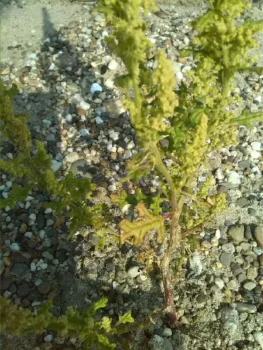
Non-native Plants

Jerusalem Oak Goosefoot

Dysphania botrys

USDA symbol: DYBO

annual forb

Canada: non-native, naturalized
Lower 48 states: non-native, naturalized

Meet Jerusalem oak goosefoot (Dysphania botrys), a quirky little annual that might just surprise you with its feathery foliage and distinctive scent. Also known as feather-geranium Jerusalem-Oak, this herb has been making itself at home across North America, though it originally hails from much farther away. Jerusalem oak goosefoot is ...

Jerusalem Oak Goosefoot: An Aromatic Annual Worth Knowing

Meet Jerusalem oak goosefoot (Dysphania botrys), a quirky little annual that might just surprise you with its feathery foliage and distinctive scent. Also known as feather-geranium Jerusalem-Oak, this herb has been making itself at home across North America, though it originally hails from much farther away.

What Exactly Is Jerusalem Oak Goosefoot?

Jerusalem oak goosefoot is a non-native annual forb that belongs to the same family as spinach and quinoa. Don’t let the goosefoot name fool you—this plant gets its moniker from the shape of its leaves, which some say resemble a goose’s webbed foot. The deeply divided, feathery foliage gives it an almost fern-like appearance that’s quite distinctive once you know what to look for.

This aromatic herb typically grows as a small, branching plant without any woody stems. It’s what botanists call a forb—essentially a non-woody flowering plant that completes its entire life cycle in a single growing season.

Where You’ll Find It Growing

Originally from the Mediterranean region and parts of Europe and Asia, Jerusalem oak goosefoot has established itself across an impressive range in North America. You can find it growing in Alabama, Arizona, Arkansas, California, Colorado, Connecticut, and dozens of other states, plus several Canadian provinces including British Columbia, Ontario, and Quebec. It’s truly made itself at home from coast to coast.

  • Species observed
  • No observations

Should You Plant Jerusalem Oak Goosefoot?

Here’s where things get interesting. While Jerusalem oak goosefoot isn’t considered invasive or particularly problematic, it’s also not a plant you’ll typically find at your local nursery. Most gardeners encounter it as a volunteer in their gardens rather than as an intentional planting.

If you’re drawn to its unique foliage and don’t mind non-native species in your garden, it can add textural interest to wild or naturalized areas. However, if you’re committed to native gardening, you might want to consider native alternatives like:

  • Wild bergamot (Monarda fistulosa) for aromatic foliage
  • Native ferns for similar feathery texture
  • Local goosefoot species native to your region

Growing Conditions and Care

One thing you can say about Jerusalem oak goosefoot—it’s not fussy. This adaptable annual prefers:

  • Full sun to partial shade
  • Well-drained soils (it’s quite drought tolerant)
  • Poor to moderately fertile soil
  • Areas with minimal competition from other plants

According to wetland indicators, this plant typically prefers upland areas and rarely grows in wetland conditions, though it can occasionally tolerate some moisture in certain regions.

The Practical Side of Things

If Jerusalem oak goosefoot shows up in your garden, you’ll notice it has a distinctive, somewhat musky scent when crushed. The small, greenish flowers aren’t particularly showy—they’re wind-pollinated, so they don’t need to attract pollinators with bright colors or nectar.

As an annual, it completes its life cycle in one season, but it’s quite good at self-seeding. If you decide you don’t want it around, it’s easy enough to pull up, especially when young.

The Bottom Line

Jerusalem oak goosefoot is one of those plants that sits comfortably in the neither here nor there category. It’s not native, but it’s not particularly harmful either. It’s not stunning, but it has its own subtle charm. Whether you choose to welcome it or weed it out really depends on your gardening philosophy and what you’re trying to achieve in your landscape.

If you do encounter it in your garden, take a moment to appreciate its feathery foliage and aromatic leaves. Sometimes the most interesting plants are the ones that choose us, rather than the other way around.

Dysphania botrys is also known as...

Often we refer to plants by their common names. When shopping for plants the scientific name is the best way to positively identify the plant species you desire. But some plants have more than one name! While it doesn't happen often, nurseries might display one name while you're searching for another. Dysphania botrys is also known as:

Botrydium botrys | USDA symbol: BOBO2
Chenopodium botrys | USDA symbol: CHBO2
Teloxys botrys | USDA symbol: TEBO2

Why do some plants have more than one name? Over time plant species may be renamed for a few reasons:

  1. Botanists in different regions named the same plant without knowing it had already been classified.
  2. A species was reclassified after scientific advances in, for example, DNA analysis.
  3. Slight variations within a species are sometimes mistakenly identified as entirely new species.

Wetland Status

The rule of seasoned gardeners and landscapers is to choose the "right plant for the right place" — matching plants to their ideal growing conditions, so they'll thrive with less care and fewer inputs. But the simplicity of this catchphrase conceals how tricky plant selection can be if you don't have the right information. While tags on nursery plants list watering requirements, there's more to the story.

Knowing a plant's wetland status can simplify the process by revealing the interaction between plants, water, and soil. You might be surprised to learn that popular landscape plants are wetland species! And what may be a wetland plant in one area, in another it might thrive in drier conditions. The table below gives insight into the preferred growing conditions of this plant throughout its geographical distribution.

Region
Preferred Habitat

Arid West (AZ, CA, CO, ID, MT, NV, NM, OR, TX, UT, WA, WY)

Facultative Upland

Atlantic and Gulf Coastal Plain (AL, AR, DC, DE, FL, GA, IL, KY, LA, MD, MS, MO, NC, NJ, OK, PA, SC, TN, TX, VA)

Facultative Upland

Eastern Mountains and Piedmont (AL, AR, DC, DE, GA, IL, IN, KS, KY, MD, MO, NC, NJ, NY, OH, OK, PA, SC, TN, VA, WV)

Obligate Upland

Great Plains (CO, KS, MN, MT, NE, NM, ND, OK, SD, TX, WY)

Facultative Upland

Midwest (IL, IN, IA, KS, KY, MI, MN, MO, NE, ND, OK, OH, SD, WI)

Facultative Upland

Northcentral & Northeast ()

Facultative Upland

Western Mountains, Valleys, and Coast (AZ, CA, CO, ID, MT, NV, NM, OR, SD, UT, WA, WY)

Facultative Upland
Wetland Glossary
Obligate Wetland
Facultative Wetland
Facultative
Facultative Upland
Obligate Upland
Almost always occurs in wetlands
Usually occurs in wetlands but may occur in non-wetlands
Can occur in wetlands and non-wetlands
Usually occurs in non-wetlands but may occur in wetlands
Almost never occurs in wetlands

Classification

Group: Dicot
Kingdom: Plantae - Plants
Subkingdom: Tracheobionta - Vascular plants
Superdivision: Spermatophyta - Seed plants
Division: Magnoliophyta - Flowering plants
Class: Magnoliopsida - Dicotyledons
Subclass: Caryophyllidae
Order: Caryophyllales
Family: Chenopodiaceae Vent. - Goosefoot family
Genus: Dysphania R. Br. - dysphania

Species: Dysphania botrys (L.) Mosyakin & Clemants - Jerusalem oak goosefoot

Plant data source: USDA, NRCS 2025. The PLANTS Database. https://plants.usda.gov,. 2/25/2025. National Plant Data Team, Greensboro, NC USA