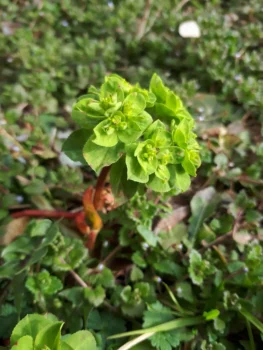
Madwoman’s Milk: The Weedy Wanderer in Your Garden
If you’ve ever noticed a small, bright green plant with peculiar umbrella-shaped flower clusters popping up uninvited in your garden, you might have encountered madwoman’s milk (Euphorbia helioscopia). This curious little annual has quite the dramatic common name, though it’s far less sinister than it sounds!
What Exactly Is Madwoman’s Milk?
Madwoman’s milk is an annual forb – essentially a non-woody herbaceous plant that completes its entire life cycle in one growing season. Like other euphorbias, it produces a milky white sap when broken or cut, which is likely how it earned its colorful common name. You might also see it referenced by its botanical synonyms Galarhoeus helioscopius or Tithymalus helioscopius in older gardening texts.
This compact plant typically reaches about 6-16 inches tall and wide, sporting bright green, oval-shaped leaves arranged in a distinctive pattern. The small yellowish-green flowers appear in flat-topped, umbrella-like clusters called umbels – a characteristic feature that makes identification relatively straightforward.
Where You’ll Find This European Transplant
Originally from Europe and western Asia, madwoman’s milk has made itself quite at home across North America. It’s now established throughout most of the United States and much of Canada, thriving in a remarkably wide range of climates from USDA zones 3 through 9.
You’ll find this adaptable annual growing in states and provinces from coast to coast, including Alberta, British Columbia, California, Texas, Maine, and everywhere in between. It’s particularly fond of disturbed soils, garden beds, roadsides, and waste areas.
- Species observed
- No observations
The Good, The Bad, and The Weedy
Here’s where things get interesting for gardeners. Madwoman’s milk isn’t typically something you’d intentionally plant, but it’s not necessarily something to panic about either. As a non-native species that readily self-seeds and spreads, it falls into that gray area of garden volunteers that aren’t quite weeds but aren’t exactly welcome guests.
Potential benefits include:
- Provides nectar for small insects and pollinators
- Extremely low-maintenance once established
- Tolerates poor soils and drought conditions
- Adds texture to wild or naturalized garden areas
Potential drawbacks include:
- Can self-seed aggressively and spread beyond desired areas
- May compete with native plants for resources
- The milky sap can be irritating to skin and eyes
- Not particularly showy or ornamental
Growing Conditions and Care
If you decide to tolerate or even encourage madwoman’s milk in certain areas of your garden, you’ll find it refreshingly undemanding. This tough little annual thrives in full sun to partial shade and isn’t picky about soil quality – in fact, it often performs better in poor, well-draining soils than in rich, amended earth.
The plant is quite drought-tolerant once established and requires virtually no supplemental watering or fertilizing. It typically germinates in spring, flowers throughout summer, and sets seed before dying back with the first frost.
A Word of Caution
While madwoman’s milk isn’t classified as aggressively invasive, its enthusiastic self-seeding habits mean it can quickly colonize disturbed areas. Always wear gloves when handling the plant, as the milky sap can cause skin irritation and is toxic if ingested by humans or pets.
Native Alternatives to Consider
If you’re drawn to the unique look of euphorbias but prefer supporting native ecosystems, consider these fantastic native alternatives:
- Flowering spurge (Euphorbia corollata) – A beautiful native with small white flowers
- Leafy spurge alternatives – Various native wildflowers that provide similar texture
- Regional native annuals – Check with your local native plant society for recommendations
The Bottom Line
Madwoman’s milk is one of those plants that gardeners typically encounter rather than seek out. While it’s not harmful to grow and does provide some ecological benefits, its non-native status and weedy tendencies make it less than ideal for intentional cultivation. If it shows up in your garden naturally, you can certainly let it be – just keep an eye on its spread and consider removing it if it starts crowding out more desirable native species.
For gardeners interested in supporting local ecosystems, exploring native alternatives will provide greater benefits to local wildlife while still satisfying any curiosity about unusual spurge family plants. After all, there’s something to be said for plants that truly belong in our gardens!