Non-native Plants

Meadow Starwort

Stellaria palustris

USDA symbol: STPA7

annual forb

Canada: non-native, naturalized
Lower 48 states: non-native, naturalized

If you’re looking for a dainty ground cover that thrives in those tricky wet spots of your garden, meadow starwort (Stellaria palustris) might catch your eye. This petite annual herb produces charming little white flowers that look like tiny stars scattered across your landscape. Meadow starwort is a small annual ...

Meadow Starwort: A Delicate Ground Cover for Moist Gardens

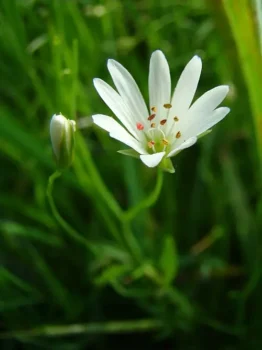
If you’re looking for a dainty ground cover that thrives in those tricky wet spots of your garden, meadow starwort (Stellaria palustris) might catch your eye. This petite annual herb produces charming little white flowers that look like tiny stars scattered across your landscape.

What is Meadow Starwort?

Meadow starwort is a small annual forb—basically a non-woody plant that completes its life cycle in one year. You might also see it listed under its botanical synonyms like Stellaria glauca or Alsine glauca in older gardening references. This delicate plant belongs to the carnation family and creates a soft, naturalized look wherever it grows.

Where Does Meadow Starwort Grow?

Originally from northern Europe and Asia, meadow starwort has made itself at home in parts of North America. Currently, you’ll find it growing in Quebec, Maine, and Wisconsin, where it reproduces on its own without any help from gardeners.

  • Species observed
  • No observations

Should You Plant Meadow Starwort?

Here’s the thing about meadow starwort—it’s not native to North America, but it’s also not considered invasive or harmful. As a responsible gardener, you have options to consider.

Reasons you might choose meadow starwort:

  • Thrives in consistently moist or wet soils where other plants struggle
  • Produces delicate white star-shaped flowers that add subtle charm
  • Self-seeds readily, filling in bare spots naturally
  • Attracts small beneficial insects like flies and gnats
  • Requires minimal maintenance once established

Consider native alternatives instead:

  • Wild ginger for shaded moist areas
  • Blue flag iris for wet sunny spots
  • Cardinal flower for dramatic color in bog gardens
  • Native sedges for year-round interest

Growing Meadow Starwort Successfully

Best Growing Conditions:

  • USDA Hardiness Zones: 3-7
  • Light: Full sun to partial shade
  • Soil: Consistently moist to wet, tolerates clay
  • Wetland status: Can grow in both wetland and non-wetland areas

Planting and Care Tips:

  • Plant seeds in early spring when soil is cool and moist
  • Keep soil consistently moist—this plant doesn’t handle drought well
  • Allow plants to self-seed if you want them to return next year
  • Expect plants to reach modest heights as ground cover
  • Minimal fertilization needed—too much can make plants leggy

Garden Design Ideas

Meadow starwort works beautifully in cottage-style gardens, naturalized areas, and rain gardens. Its delicate white flowers complement bolder blooms without overwhelming them. Consider it for pond margins, alongside streams, or in any spot that stays consistently moist throughout the growing season.

The small flowers may not be showy, but they provide nectar for tiny beneficial insects that larger flowers might overlook. This makes meadow starwort a subtle but valuable addition to pollinator-friendly gardens.

The Bottom Line

Meadow starwort offers a gentle solution for challenging wet spots in your garden. While it’s not native, it’s also not problematic—making it a neutral choice for gardeners who appreciate its delicate beauty and easy-care nature. Just remember that choosing native alternatives will better support your local ecosystem and wildlife.

Stellaria palustris is also known as...

Often we refer to plants by their common names. When shopping for plants the scientific name is the best way to positively identify the plant species you desire. But some plants have more than one name! While it doesn't happen often, nurseries might display one name while you're searching for another. Stellaria palustris is also known as:

Alsine glauca | USDA symbol: ALGL10
Stellaria fennica auct. non | USDA symbol: STFE2
Stellaria glauca | USDA symbol: STGL3

Why do some plants have more than one name? Over time plant species may be renamed for a few reasons:

  1. Botanists in different regions named the same plant without knowing it had already been classified.
  2. A species was reclassified after scientific advances in, for example, DNA analysis.
  3. Slight variations within a species are sometimes mistakenly identified as entirely new species.

Wetland Status

The rule of seasoned gardeners and landscapers is to choose the "right plant for the right place" — matching plants to their ideal growing conditions, so they'll thrive with less care and fewer inputs. But the simplicity of this catchphrase conceals how tricky plant selection can be if you don't have the right information. While tags on nursery plants list watering requirements, there's more to the story.

Knowing a plant's wetland status can simplify the process by revealing the interaction between plants, water, and soil. You might be surprised to learn that popular landscape plants are wetland species! And what may be a wetland plant in one area, in another it might thrive in drier conditions. The table below gives insight into the preferred growing conditions of this plant throughout its geographical distribution.

Region
Preferred Habitat

Midwest (IL, IN, IA, KS, KY, MI, MN, MO, NE, ND, OK, OH, SD, WI)

Facultative

Northcentral & Northeast ()

Facultative
Wetland Glossary
Obligate Wetland
Facultative Wetland
Facultative
Facultative Upland
Obligate Upland
Almost always occurs in wetlands
Usually occurs in wetlands but may occur in non-wetlands
Can occur in wetlands and non-wetlands
Usually occurs in non-wetlands but may occur in wetlands
Almost never occurs in wetlands

Classification

Group: Dicot
Kingdom: Plantae - Plants
Subkingdom: Tracheobionta - Vascular plants
Superdivision: Spermatophyta - Seed plants
Division: Magnoliophyta - Flowering plants
Class: Magnoliopsida - Dicotyledons
Subclass: Caryophyllidae
Order: Caryophyllales
Family: Caryophyllaceae Juss. - Pink family
Genus: Stellaria L. - starwort

Species: Stellaria palustris (Murray) Retz. - meadow starwort

Plant data source: USDA, NRCS 2025. The PLANTS Database. https://plants.usda.gov,. 2/25/2025. National Plant Data Team, Greensboro, NC USA