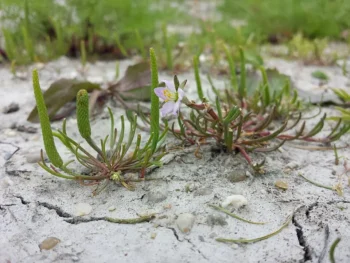
Media Sandspurry: A Tough Little Ground Cover for Challenging Spots
If you’re dealing with those frustrating garden spots where nothing seems to thrive – you know, the salty, sandy, or just plain stubborn areas – you might want to meet media sandspurry (Spergularia maritima). This unassuming little plant has made quite a name for itself as a survivor, though it’s not exactly what you’d call a garden showstopper.
What Exactly Is Media Sandspurry?
Media sandspurry is a low-growing forb that can live as either an annual or perennial, depending on conditions. Think of it as the plant equivalent of that friend who’s equally comfortable camping or staying in a five-star hotel – it just adapts. You might also encounter it under its scientific synonyms Spergularia marginata or Spergularia media, but let’s stick with the name that won’t make your tongue tie itself in knots.
This little ground-hugger produces delicate pink or white flowers and forms spreading mats with tiny, linear leaves. It’s not going to win any beauty contests, but it has a subtle charm that grows on you – literally and figuratively, since it tends to self-seed quite enthusiastically.
Where You’ll Find It Growing Wild
Originally from coastal regions of Europe, the Mediterranean, and western Asia, media sandspurry has become quite the world traveler. It’s now established across much of North America, including California, Colorado, Illinois, Indiana, Massachusetts, Michigan, Missouri, Montana, New Jersey, New Mexico, New York, North Dakota, Ohio, Oregon, Pennsylvania, Utah, Washington, Wyoming, and parts of Canada including Ontario and Quebec.
- Species observed
- No observations
The Not-So-Native Status
Here’s where things get a bit complicated. Media sandspurry isn’t native to North America – it’s what botanists call a naturalized species. It arrived from elsewhere, liked what it found, and decided to stay. The good news is that it’s not currently listed as invasive or noxious, so you won’t be breaking any ecological rules by growing it. However, if you’re passionate about supporting local ecosystems, you might want to consider native alternatives first.
Growing Conditions: The Set It and Forget It Plant
Media sandspurry thrives in USDA hardiness zones 3-9, which covers most of the continental United States. It’s remarkably unfussy about its living conditions:
- Loves full sun but tolerates some shade
- Thrives in poor, sandy, or gravelly soils that make other plants sulk
- Extremely salt tolerant – perfect for coastal areas or roadsides treated with winter salt
- Drought tolerant once established
- Can handle both wet and dry conditions, though it leans toward the drier side in most regions
Wetland Flexibility
One of media sandspurry’s more interesting traits is its wetland status flexibility. Depending on your region, it might prefer wetlands, uplands, or show no particular preference at all. In western areas, it tends to favor wetland conditions, while in the Great Plains and Midwest, it’s more of an upland dweller. Talk about adaptable!
Garden Role and Design Uses
Media sandspurry works best as:
- Ground cover for difficult sites where other plants struggle
- Filler in rock gardens or xerophytic landscapes
- Coastal garden plantings where salt tolerance is crucial
- Low-maintenance areas that need some green coverage
It’s not going to be the star of your perennial border, but it excels at solving problems in challenging locations.
Planting and Care Tips
Growing media sandspurry is refreshingly simple:
- Plant seeds directly in spring or fall – they need little soil preparation
- Space plants about 6-12 inches apart if using transplants
- Water lightly until established, then largely ignore it
- No fertilization needed – it actually prefers poor soils
- Deadhead flowers if you want to prevent aggressive self-seeding
Pollinator and Wildlife Benefits
While media sandspurry’s flowers are small, they do provide nectar for small pollinators like bees and beneficial insects. The seeds may also provide food for some bird species, though it’s not a wildlife magnet by any means.
The Bottom Line: Should You Plant It?
Media sandspurry is like that reliable friend who shows up when others can’t – it’s not flashy, but it gets the job done. If you have challenging sites with poor soil, salt exposure, or drought conditions, it might be worth considering. However, if you’re focused on supporting native ecosystems, explore native alternatives first. Many regions have native plants that can handle similar tough conditions while providing better wildlife support.
Before planting, check with your local native plant society or extension office for native ground covers that might work for your specific situation. Sometimes the best solution is the one that’s been there all along – it just needed someone to point it out.