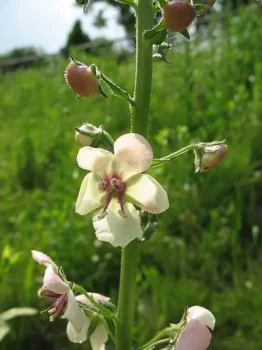
Moth Mullein: A European Wildflower That’s Made Itself at Home
If you’ve ever spotted a tall, slender plant with delicate white or pale yellow flowers dotting roadsides or vacant lots, chances are you’ve encountered moth mullein (Verbascum blattaria). This European native has become quite the world traveler, establishing itself across North America with the kind of determination that would make any pioneer proud.
What Exactly Is Moth Mullein?
Moth mullein is a biennial forb, which is just a fancy way of saying it’s a non-woody plant that takes two years to complete its life cycle. In its first year, it forms a neat rosette of leaves close to the ground, quietly gathering strength. Come year two, it sends up an impressive flowering spike that can reach 2-4 feet tall, sometimes even taller when it’s feeling particularly ambitious.
The flowers are the real showstoppers – small but numerous, each adorned with distinctive purple stamens that look like tiny fuzzy antennae. These blooms open sporadically along the stem throughout the summer, creating a subtle but charming display.
Where You’ll Find This Wandering Wildflower
Originally from Europe and Asia, moth mullein has made itself comfortable across an impressive range in North America. It now grows throughout most of the continental United States and parts of Canada, including Alabama, Arizona, Arkansas, California, Colorado, Connecticut, Delaware, Florida, Georgia, Hawaii, Idaho, Illinois, Indiana, Iowa, Kansas, Kentucky, Louisiana, Maine, Maryland, Massachusetts, Michigan, Mississippi, Missouri, Montana, Nebraska, Nevada, New Hampshire, New Jersey, New Mexico, New York, North Carolina, North Dakota, Ohio, Oklahoma, Oregon, Pennsylvania, Rhode Island, South Carolina, South Dakota, Tennessee, Texas, Utah, Vermont, Virginia, Washington, West Virginia, Wisconsin, plus British Columbia, New Brunswick, Ontario, and Quebec.
- Species observed
- No observations
The Good, The Bad, and The Seedy
Before you decide whether moth mullein deserves a spot in your garden, let’s weigh the pros and cons:
Why You Might Love It:
- Extremely low maintenance once established
- Thrives in poor, disturbed soils where other plants struggle
- Provides nectar for bees, butterflies, and other pollinators
- Adds vertical interest with its tall flowering spikes
- Perfect for cottage gardens or naturalized areas
- Drought tolerant and adaptable
Why You Might Think Twice:
- Self-seeds enthusiastically (some might say aggressively)
- Can spread beyond where you originally planted it
- May crowd out native wildflowers in naturalized settings
- Takes up space the first year without flowering
Growing Moth Mullein Successfully
If you decide to give moth mullein a try, you’ll be pleased to know it’s about as fuss-free as plants come. Hardy in USDA zones 3-9, it adapts to a wide range of conditions but performs best in full sun with well-drained soil.
Planting and Care Tips:
- Sow seeds directly in fall or early spring
- Choose a sunny location with average to poor soil
- Water sparingly – this plant prefers to stay on the dry side
- Remove spent flower spikes promptly to prevent excessive self-seeding
- Allow some plants to go to seed if you want them to return next year
- No fertilizing necessary – it actually prefers lean conditions
A Note About Wetlands
Moth mullein is decidedly a dry-land lover. Across most regions, it’s classified as Obligate Upland, meaning it almost never occurs in wetlands. In a few areas (Atlantic and Gulf Coastal Plain, Midwest, and Northcentral & Northeast regions), it’s listed as Facultative Upland, which means it usually sticks to non-wetland areas but might occasionally venture into wetter spots.
Consider Native Alternatives
While moth mullein isn’t considered invasive, supporting native plants is always a great choice for local ecosystems. Consider these native alternatives that offer similar tall, flowering spikes:
- Wild bergamot (Monarda fistulosa)
- Purple coneflower (Echinacea purpurea)
- Wild lupine (Lupinus perennis)
- Great mullein (Verbascum thapsus) – though this is also non-native
The Bottom Line
Moth mullein is like that friend who shows up uninvited but turns out to be pretty good company. It’s not going to win any Plant of the Year awards, but it brings a quiet charm to disturbed areas and cottage gardens while asking for practically nothing in return. Just keep an eye on its seeding habits, and you’ll likely find it a pleasant, if persistent, garden companion.
Whether you embrace its free-spirited nature or prefer to admire it from roadsides, moth mullein has certainly earned its place in the North American landscape – one tiny purple-stamened flower at a time.