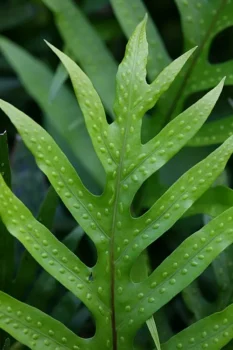
Non-native Plants

Musk Fern

Phymatosorus grossus

USDA symbol: PHGR61

perennial forb

Hawaii: non-native, naturalized
Puerto Rico: non-native, naturalized

If you’ve been exploring ferns for your garden and stumbled across the musk fern, you’re probably wondering what exactly this plant is all about. Known botanically as Phymatosorus grossus, this perennial fern has been making itself at home in some tropical locations, though it’s not exactly a household name in ...

Musk Fern: Getting to Know This Tropical Newcomer

If you’ve been exploring ferns for your garden and stumbled across the musk fern, you’re probably wondering what exactly this plant is all about. Known botanically as Phymatosorus grossus, this perennial fern has been making itself at home in some tropical locations, though it’s not exactly a household name in the gardening world yet.

What is Musk Fern?

Musk fern, also called maile-scented fern, is a non-woody perennial plant that falls into the forb category. Don’t let the technical terminology fool you—this simply means it’s a soft-stemmed plant without significant woody growth above ground, and it comes back year after year. Like all ferns, it reproduces through spores rather than flowers and seeds.

Where You’ll Find It Growing

Currently, musk fern has established populations in Hawaii and Puerto Rico, where it reproduces on its own in the wild. This fern is considered non-native to these locations, meaning it originally came from somewhere else but has successfully adapted to these tropical environments.

  • Species observed
  • No observations

Garden Habitat Preferences

When it comes to moisture preferences, this fern shows some interesting regional variations:

  • In Hawaii: Usually prefers drier, upland areas but can tolerate some moisture
  • In Puerto Rico and Atlantic coastal regions: Almost always found in upland, non-wetland areas

This suggests musk fern is quite adaptable but generally prefers well-draining conditions over soggy soil.

Should You Grow Musk Fern?

Here’s where things get a bit tricky. While musk fern isn’t currently listed as invasive or noxious, its status in these categories is still unknown. This means we simply don’t have enough information yet to know how aggressively it might spread or whether it could potentially impact native ecosystems.

If you’re drawn to ferns for your tropical or subtropical garden, you might want to consider exploring native fern alternatives first. Native ferns will be better adapted to your local conditions, support local wildlife, and won’t pose any risk of becoming problematic.

What We Don’t Know Yet

Unfortunately, there’s still quite a bit we don’t know about musk fern, including:

  • Its specific growing requirements and care needs
  • How it benefits (or doesn’t benefit) local wildlife
  • Its exact growth form and mature size
  • The best propagation methods
  • Its potential invasiveness

The Bottom Line

Musk fern represents one of those interesting cases where a plant has successfully established itself in new locations, but we’re still learning about its full impact and characteristics. While it’s not currently flagged as problematic, the gaps in our knowledge suggest it might be wise to take a wait-and-see approach.

If you’re specifically interested in adding ferns to your tropical garden, consider researching native fern species in your area first. They’ll give you that lush, tropical look you’re after while supporting your local ecosystem—and you’ll have much better information about how to grow them successfully!

Phymatosorus grossus is also known as...

Often we refer to plants by their common names. When shopping for plants the scientific name is the best way to positively identify the plant species you desire. But some plants have more than one name! While it doesn't happen often, nurseries might display one name while you're searching for another. Phymatosorus grossus is also known as:

Phymatosaurus grossus Brownlie, orth. var. | USDA symbol: PHGR21
Phymatosorus scolopendria auct. non | USDA symbol: PHSC61

Why do some plants have more than one name? Over time plant species may be renamed for a few reasons:

  1. Botanists in different regions named the same plant without knowing it had already been classified.
  2. A species was reclassified after scientific advances in, for example, DNA analysis.
  3. Slight variations within a species are sometimes mistakenly identified as entirely new species.

Wetland Status

The rule of seasoned gardeners and landscapers is to choose the "right plant for the right place" — matching plants to their ideal growing conditions, so they'll thrive with less care and fewer inputs. But the simplicity of this catchphrase conceals how tricky plant selection can be if you don't have the right information. While tags on nursery plants list watering requirements, there's more to the story.

Knowing a plant's wetland status can simplify the process by revealing the interaction between plants, water, and soil. You might be surprised to learn that popular landscape plants are wetland species! And what may be a wetland plant in one area, in another it might thrive in drier conditions. The table below gives insight into the preferred growing conditions of this plant throughout its geographical distribution.

Region
Preferred Habitat

Atlantic and Gulf Coastal Plain (AL, AR, DC, DE, FL, GA, IL, KY, LA, MD, MS, MO, NC, NJ, OK, PA, SC, TN, TX, VA)

Obligate Upland

Caribbean (PR, VI)

Obligate Upland

Hawaii ()

Facultative Upland
Wetland Glossary
Obligate Wetland
Facultative Wetland
Facultative
Facultative Upland
Obligate Upland
Almost always occurs in wetlands
Usually occurs in wetlands but may occur in non-wetlands
Can occur in wetlands and non-wetlands
Usually occurs in non-wetlands but may occur in wetlands
Almost never occurs in wetlands

Classification

Group: Fern
Kingdom: Plantae - Plants
Subkingdom: Tracheobionta - Vascular plants
Division: Pteridophyta - Ferns
Class: Filicopsida
Order: Polypodiales
Family: Polypodiaceae J. Presl & C. Presl - Polypody family
Genus: Phymatosorus Pic. Serm. - phymatosaurus

Species: Phymatosorus grossus (Langsd. & Fisch.) Brownlie - musk fern

Plant data source: USDA, NRCS 2025. The PLANTS Database. https://plants.usda.gov,. 2/25/2025. National Plant Data Team, Greensboro, NC USA