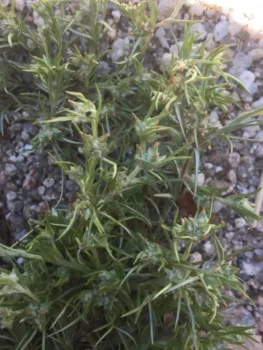
Narrowleaf Cottonrose: A Quiet Mediterranean Annual for Your Garden
If you’re drawn to understated plants with a story to tell, narrowleaf cottonrose (Logfia gallica) might catch your interest. This small Mediterranean annual has quietly made its way to parts of the United States, where it grows as an unassuming member of the aster family. While it won’t win any beauty contests, this little plant has its own subtle charm and fascinating adaptations.
What is Narrowleaf Cottonrose?
Narrowleaf cottonrose is an annual forb—essentially a non-woody plant that completes its entire life cycle in one growing season. Originally from the Mediterranean region of Europe, this plant belongs to a group that was once classified under the genus Filago, which explains one of its scientific synonyms, Filago gallica.
As a member of the aster family, narrowleaf cottonrose produces tiny, inconspicuous flower heads that cluster together. The plant’s most distinctive feature is its woolly, grayish-green foliage that gives it a soft, cotton-like appearance—hence the cottonrose part of its common name.
Where Does It Grow?
In the United States, narrowleaf cottonrose has established populations in California, Hawaii, and Oregon. It’s important to note that this plant is considered non-native in these areas, meaning it was introduced from elsewhere and now reproduces on its own in the wild.
- Species observed
- No observations
Should You Grow Narrowleaf Cottonrose?
The honest answer is: probably not, unless you have a very specific reason. Here’s why:
- Limited ornamental value: The flowers are tiny and not particularly attractive
- Non-native status: As an introduced species, it doesn’t support local ecosystems as effectively as native plants
- Minimal wildlife benefits: Its small flowers provide limited resources for pollinators
- Better alternatives exist: Native plants will serve your garden and local wildlife much better
However, if you’re creating a Mediterranean-themed garden, studying plant geography, or simply fascinated by the botanical travelers that have found new homes across the globe, narrowleaf cottonrose could be an interesting addition to a specialized collection.
Native Alternatives to Consider
Instead of narrowleaf cottonrose, consider these native alternatives that offer similar growing conditions but greater ecological benefits:
- California everlasting (Pseudognaphalium californicum) – offers similar woolly foliage with better wildlife value
- Fragrant everlasting (Pseudognaphalium canescens) – provides cottony texture with native credentials
- Local native asters and sunflowers – deliver the aster family connection with superior pollinator support
Growing Conditions and Care
If you do decide to grow narrowleaf cottonrose, the good news is that it’s remarkably easy to please:
- Sunlight: Full sun
- Soil: Prefers poor, sandy, or gravelly soils; actually performs better in low-fertility conditions
- Water: Minimal water needs once established; drought tolerant
- Climate zones: Grows in USDA zones 8-10 where it can complete its annual cycle
Planting and Maintenance Tips
Narrowleaf cottonrose is refreshingly low-maintenance:
- Scatter seeds in fall or early spring directly where you want them to grow
- Barely cover seeds with soil—they need light to germinate
- Avoid fertilizing; rich soils actually discourage this plant
- Water sparingly, only during extended dry periods
- Allow plants to self-seed if you want them to return next year
The Bottom Line
While narrowleaf cottonrose won’t transform your garden into a showstopper, it represents an interesting piece of botanical history—a small Mediterranean traveler that has adapted to life in new climates. If you’re passionate about native gardening and supporting local ecosystems, though, you’ll find much better options among your region’s indigenous plants. Sometimes the most responsible gardening choice is also the most rewarding one, both for your landscape and the wildlife that calls it home.